F2P Design Rules

f2p-design-rulesOver the weekend I read Design Rules for Free-to-Play Games by Nicholas Lovell and Rob Fahey from Games Brief.  It’s a quick little ebook that I was able to read sitting around on short airport layovers.  The business model of the pamphlet itself is kind of interesting.  It’s essentially a cleaned-up, extended collection of some of their blog posts on the topic, with which they’re trying ot hook in more regular readers as well as purchasers of some of their extravagantly priced other material.  At $3 though this one is pretty reasonable.  You could get the same content trawling through their website, let alone others, but it doesn’t seem like a ripoff to have a polished, extended production in a convenient package.

These are the basic rules they establish:

  • Make it fun.  This should be obvious, but a lot of F2P designers are clearly not really thinking about making games, let alone fun games, as much as they trying to create the minimum possible engine for extracting the maximal possible cash from a player.
  • The Starbucks test.  Players should be able to do something engaging and complete within just a couple minutes.  Jump in, play, get a rush, get hooked.
  • Come for a minute, stay for an hour.  Make the core game last just a few minutes—the Starbucks test—but wrap it in longer loops of complexity, challenges, and/or appointments to keep people playing and returning.
  • Complexity in layers.  Give players of all types something with which to engage: Achievers, Explorers, Socializers, Killers (the Bartle types).
  • The importance of never ending.  Figure out a game design without finite duration so people can just keep playing endlessly.
  • Be generous.  Giving people things and not being tight with game rewards will make them like you more, keep coming back, and spend generously in return.
  • Be free-to-play forever.  Throwing up a paywall is booting players unnecessarily, after you’ve gone to all the trouble to acquire and retain them.
  • The no-brainer first dollar.  Have an in-app-purchase that people would be crazy to not purchase, some kind of great deal.
  • Make it possible to spend $100.  Don’t impose an upper bound on how much people can spend.  If they want to drop a ton of money, let them!
  • Have pizzazz, not polish.  You don’t need to nail down every little detail that players won’t notice.  You do need to give lots of feedback and rewards—animations, sounds, and so on.
  • Kill the tutorial.  Don’t waste time before showing players the good stuff and getting into the engrossing action, they’re not going to give you the benefit of the doubt as they might for a paid product.
  • I must not fail.  Avoid killing off players or otherwise blocking their progress.  You want them to always be able to see some way to continue moving forward.
  • Sell emotion, not content.  Players don’t care how much things cost to make.  They care about buying a better experience.
  • Experiment and learn.  Run principled experimentation, collecting data from well instrumented games, to figure out what’s working and what’s not.
  • Game development never ends.  Continually tweak and tune.

There is also a small but reasonable glossary, with a small selection of key F2P terms and concepts explained.

I think it’s misleadingly tempting to declare these design rules “obvious.”  To me, pretty much all of them make intuitive sense upon being presented.  But the opposite are in many cases also intuitive and more traditional.  A good example is imposing a paywall, having a player pay for more content.  Clearly that’s a viable approach to monetizing a game, and has a long history.  But Lovell and Fahey argue quite a bit, I think convincingly so, that this is not actually a Free-to-Play model, it’s just a rehash of demos and shareware of years past.

Many of these also seem hard to achieve, which is fascinating.  A leading example is enabling players to spend up to $100/month.  Caveat devoting a lot of effort to generating large new content like level packs, that seems really challenging.  Even if you’re generating and selling a lot of small content (hats!), how do you get a particular player to keep buying variations?  If you’re not selling content, what kind of gameplay and purchases do you need such that they can keep spending money but you’re not just shilling for extra lives or such?  It’s actually quite a challenge to think up game designs that meet many of these guidelines, which to me says that there’s probably some thought and value to them.

There’s more explication and rationale in the book, so I encourage those interested in these kinds of things to either pick it up or go trawling through the Games Brief blog for the original source posts.

Gold Leader @ 50,000

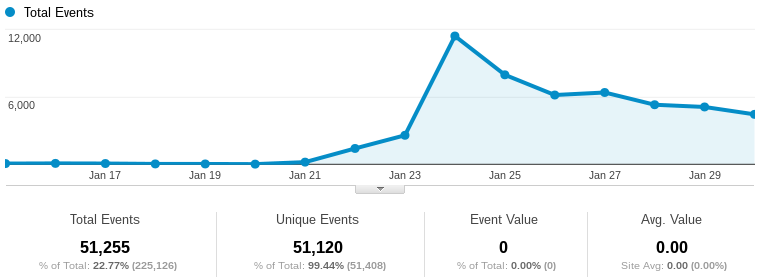
goldleader-iconSometime today Gold Leader crossed 50,000 unique viewers.  Together they’ve played just under 76,000 times over the two weeks it’s been released.

Of course, “unique” is not a strictly literal term.  I’m not sure how Google Analytics determines uniqueness exactly, but people coming back after some time are clearly included.  In some sense that doesn’t matter much in terms of counting eyeballs for ads and such and there’s no other real mechanism without any sort of accounts or such, so that’s the kind of number that generally gets bandied about.

As noted by the stats on the main blog, the game remains much too hard: Only about 14% of all players are beating the first mission objective.  I can only imagine what that’s doing to the repeat plays, or presumed lack thereof.  About 4000 people have loaded the game and not started a mission. I guess it just wasn’t what they’re looking for.

Almost all of the plays actually come from the last week.  The first week after launch (Jan 16) the game was getting a steady thousand views/day or so on GameShed.  Once it went viral to all the ridiculously many Flash sites around the net though, the plays spiked quite dramatically (about Jan 22).  Views are trending down now as the game falls off their front pages, but I really have no idea what the lifetime is.  Hopefully it settles on some sort of steady number of plays and doesn’t bottom out completely though it’s hard to believe that won’t happen given the steady deluge of games hitting the Web.

goldleader-players

Plot of game load events as captured in Google Analytics.

I’ve had some trouble coming up with numbers for typical Flash game plays so I’m not sure how this compares.  Many sponsors don’t allow developers to collect stats, and many developers are cagey about revealing what they do know.  Clearly it’s no Angry Birds or even a moderate hit, but it also certainly doesn’t seem to be the bottom of the barrel either.

Either way, that’s a pretty satisfying number and was actually my admittedly under-informed target: 50,000 players in two weeks.  50,000 people is a lot of people!  I guess it’s not “Internet scale,” but even accounting for some reasonable fraction being repeat players that’s still an absurd amount of people to have played my little shoot ’em up.

To put it in one perspective of interest to me, I’ve published research articles in several high profile venues, most notably in terms of numbers some of the major IEEE magazines such as Internet Computing.  An optimistic readership number I’ve heard for those higher profile venues is 5000 people, and presumably some fraction thereof reading any given individual article.  This is an order of magnitude more!  And it’s god knows how far from putting games up on the Web ten to fifteen years ago, when I was probably optimistically getting a very low couple hundred players, mostly through the Allegro community.

For the most part this is actually not as emotional as some of the early super enthusiastic reviews on FGL, but it’s still really cool and deeply rewarding.  It’s also somewhat educational.  Though fairly obvious beforehand, the data confirms that even for a lower profile game like this, the resources consumed would be pretty substantial for a single host.  If I moved the leaderboard or analytics off Mochi and Google, or provided any kind of multiplayer, online updates, or downloadable content, I would need some serious infrastructure to manage it.  Fortunately, I’m on top of it.  To the future!

Installing Haxe/NME on Arch Linux x86_64

haxeSome updated notes on Haxe 3 and OpenFL are now available.

I love Haxe and NME.  But they’re at times not the most pleasantly packaged of software.  There are some definite lapses in checking the released versions for packaging problems, the nightly snapshots often have problems, and few of the setup scripts will work if you’re not using an apt-based system (i.e., Ubuntu). Having just installed on two 64bit machines running Arch Linux, the following are some notes on getting it all to work.

Flash Player

You’ll have to install the 32bit multilib stuff in order to install the Flashplayer standalone debug player.  You definitely want this as the debug player seems to be the only way to get reports on null pointers and such in your Flash programs.

Enable the multilib repository by editing /etc/pacman.conf to uncomment:

[multilib]
SigLevel = PackageRequired
Include = /etc/pacman.d/mirrorlist

Then udate the repo DB and install the multilibs:

sudo pacman -Syu
sudo pacman -S gcc-multilib

Accept everything pacman asks in running that command. Then install the player.

sudo packer -S flashplayer-standalone-debug

Haxe/NME Toolchain

The Haxe/NME stack includes a number of components. You could try installing these from the NME install script, but it’s based on Ubuntu and several components won’t work even after you adjust for that. Instead you need to cherry pick some parts and replace others.  The rest of this sort of follows the script, but injects some variations and other steps.

The first thing to install is Neko. You want to do this from the AUR package, e.g.:

sudo packer -S neko

Installing from the tarball like the NME script does will result in a broken dependency with libpcre3. Manually compiling from source to fix that seems to be a rathole, and using the AUR package seems cleaner than jury-rigging a .so fix.

Next is Haxe itself. Tragically, you seemingly don’t want to pull this from the AUR package. I haven’t looked at it closely to confirm, but believe it pulls from SVN, which often leads to problems. Today on installing from that I get errors along the lines of “Missing Standard library.” (not an exact quote). Instead, download the stable release and patch up an install:

wget -c http://haxe.org/file/haxe-2.10-linux.tar.gz
tar xzvf haxe-2.10-linux.tar.gz
sudo mkdir -p /usr/lib/haxe/lib
sudo chmod -R 777 /usr/lib/haxe/lib

sudo cp -r haxe-2.10-linux/* /usr/lib/haxe
sudo ln -s /usr/lib/haxe/haxe /usr/bin/haxe
sudo ln -s /usr/lib/haxe/haxelib /usr/bin/haxelib
sudo ln -s /usr/lib/haxe/haxedoc /usr/bin/haxedoc

haxe /usr/lib/haxe/std/tools/haxelib/haxelib.hxml
sudo cp haxelib /usr/lib/haxe/haxelib

haxe /usr/lib/haxe/std/tools/haxedoc/haxedoc.hxml
sudo cp haxedoc /usr/lib/haxe/haxedoc

sudo haxelib setup /usr/lib/haxe/lib

wget -c http://www.haxenme.org/builds/hxcpp-2.10.3.zip
sudo haxelib test hxcpp-2.10.3.zip

Finally, install NME and friends.  Begin with the basic download.

sudo haxelib install nme

From here I have tremendous problems.  Nothing will actually work yet, including the rest of the setup process; I simply get errors from tls.ndll about missing libopenssl.so.0.9.8. Seemingly there is a persistent problem in the packaging of NME such that it’s not properly searching the appropriate 64/32 bit Neko libraries. At this point you’re standing on the edge of a huge rathole. Compiling NME from source seems to be fairly complex to setup outside of the assumed Ubuntu environment. Installing that version of OpenSSL doesn’t work because it’s 32 bit. After repeatedly screwing around with this at length on several major releases of NME, short of setting up NME from source I don’t think you have any option here but the ugliest:

cd /usr/lib
sudo ln -s libssl.so.1.0.0 libssl.so.0.9.8
sudo ln -s libcrypto.so.1.0.0 libcrypto.so.0.9.8
cd -

Now you can continue installing and hope you haven’t just set some lurking booby trap to slam you on some other project months down the road…

sudo haxelib run nme setup
sudo haxelib install actuate
sudo haxelib install svg
sudo haxelib install swf

At this point things should work. However, I had trouble getting some of the RocketHaxe demos to compile with NME 3.5.4. It produced inscrutable and inexplicable errors about exceptions creating the output files. Updating to 3.5.5 seemed to fix these; I have no idea what else it broke in return. You can upgrade to a nightly build by downloading a new version from the NME builds repository. Then have haxelib switch to that version, e.g.:

sudo haxelib test nme-3.5.5-165-g354e1e6.zip

Test

Now you should be able to test everything out. Go into a random temporary directory and build a sample program:

nme create Addingtext
cd AddingText
nme build project.nmml flash
flashplayerdebugger Export/flash/bin/AddingText.swf

If that works, it works. If it doesn’t… Slaugther a chicken and call a priest or something. Please leave any comments you have about improvements to this process or other notes. Thanks!

Further notes about setting up Haxe for Android development are here.