Redcap’s 40k 1000pt December Tournament

kingbreakers-iconColin, Jason, Justin, Lovell, and I went out for Redcap’s December monthly tournament yesterday.  Three games, 1000pts, standard missions and force organization.  Final standings:

  • Chaos Marines (Chris)—16
  • Tyranid (Byron)—11
  • Tie: Chaos Marines (Colin) and Chaos Marines (James)—10
  • Space Marines (Joe)—9
  • Eldar (Justin)—8
  • Dark Angels (Jason)—7
  • Tyranid (Lovell)—4

Missions were drawn from the standard rulebook with straightforward bonuses:

  • Big Guns Never Tire/Hammer and Anvil/Bonus: No enemy units in their deployment zone.
  • Crusade/Dawn of War/Bonus: Warlord ends game in enemy deployment zone.
  • Relic/Vanguard Strike/Bonus: Your warlord slays enemy warlord.

These were my first games in 6th edition after a good length hiatus in general.  In addition to the PAGE guys going, this tournament worked out well as a re-introduction.  The low points limit kept out crazy units and complicated rules, as well as giving plenty of time to play.

IMG_5719

Army

I took a pretty simple list, inspired by two criterion:

  • I was willing to bend on this, but I really wanted to take a fully painted force.
  • I wanted to keep everything super simple and familiar to me so I could just focus on the core 6ed rule changes.

I wound up taking 1000pts exactly:

  • Captain Angholan (Vulkan)
  • Sternguard x10 w/ Powersword, 6xCombi-Meltas, Multi-Melta, Drop Pod
  • Tactical x10 w/ Powerfist, Plasmagun, Missile Launcher, Razorback w/ Hunter-Killer
  • Tactical x10 w/ Chainsword, Meltagun, Missile Launcher, Rhino w/ Hunter-Killer

In the end everything was painted except the magnetized hunter-killers and two guys’ bases.

Round 1

First I faced Justin and his Eldar.  All four objectives wound up tightly clustered near the center of the table.  For my part, I’d encouraged this because I figured it would lead to more close combat scraps over objectives, which I figured my stalwart Marines would tend to win.

In the end I claimed a massacre, but it was super bloody.  I only had five guys plus the captain and a Rhino left, facing fifteen or more Eldar.  However, the Eldar had all been pushed away from the objectives and had not claimed any bonuses.  One interesting thing about this was that much of it was done by tank shocking the Eldar away from objectives.  This was done a couple times, but a late game charge by the remaining empty Rhino cleared the Eldar off their last objective, swinging the Kingbreakers from a major victory to a massacre.  Also of note was that my captain’s Warlord Trait made him a scoring unit.  In the end it didn’t matter in some sense as a single tactical Marine was left standing on the central objective with him, but it seemed powerful that the highly robust (2+/3++) Angholan would have been able to hold that objective all by himself.

Usually you should try to *not* be completely surrounded...

Usually you should try to *not* be completely surrounded…

Round 2

Next came Chris, the eventual winner, and his Chaos Marines.  He was able to tightly cluster three objectives in his zone.  I put my two pretty far away, more or less tucked into a relatively remote corner.  The final score on victory points wound up being 10–8, Chaos.

For the most part this was a fairly close game.  Other than three Rhinos, Chris didn’t have a ton of mobility, so I felt fairly safe leaving just a combat squad each to guard my two home objectives, and they indeed wound up unmolested the whole game.  The Sternguard dropped into the heart of the Chaos objective cluster and did a reasonable job of gumming up everything in there.  Between pressure from them and a flanking sweep from the remaining Tac Marines, the Chaos right side was rolling up and at least a third objective definitely achievable, if not a fourth.  As expected though, a pair of Obliterators came down behind that flank and I decided to fight them.  On the one hand, they got pretty lucky and rolled a large number of 5+ saves for several turns, stalling out my entire offensive.  On the other hand, I maybe should have just ignored them; it was probably a mistake to fight them rather than just roll on.  They would have been lethal, but if the push had just kept going it may have been able to gain enough distance to settle on the objective and effectively ignore them.  Contrarily though, they’re not as slow as they used to be with the changes to Slow + Purposeful, so that would not have been as effective a move as in 5e.

Oblits begin to stall out the Kingbreakers' flanking rush.

Oblits begin to stall out the Kingbreakers’ flanking rush.

One other thought about the mission was that allowing the first player to place an uneven number of objectives seems like a significant advantage.  Especially when they’re playing armies that want to get into a close quarters fight, it seems unfortunate for the first player to be given a significant lead from the get-go and be able to play more defensively.

Also, between all the Traits, Boons, and Demon Weapons, even fairly standard Chaos Lords seem to be able to throw down an astounding number of close combat attacks now.

Chaos hunkers down around the local watering hole...

Chaos hunkers down around the local watering hole…

Round 3

After that slight loss I went against Byron and his Tyranid.  To some extent I was starting to fade here.  Between getting up super early to cram for a few hours on the new rules and already playing for 4 hours, it was a fair bit of 40k from a cold start.  Compounding that, I don’t have a ton of experience against the latest Tyranid codex.  It seems like it has fared well with the new rulebook.  I thought it also well suited for the Relic mission.  A Tervigon with Iron Arm cast on it is a pretty imposing scoring unit for carrying the relic around…

Oh yeah, you bad!  (this Tervigon's actually in Lovell's army)

Oh yeah, you bad! (this Tervigon’s actually in Lovell’s army)

I think my biggest problem though was not having any psychic protection.  It’s tough to fit two Marine HQs into 1000pts and Vulkan’s so useful that I’m not sure I’d have taken a librarian even if I hadn’t consciously set him aside as I wouldn’t have been really up on the new rules for using him.  However, a hood or something would be really useful.  Most of the Tyranid spent the game walking around covered by a Telekine Dome, both making them extraordinarily harder to kill than they usually are, and hurting my own guys as shots bounced back.  If I’d been able to counter that at least once in a while things could have turned out much differently from the massacre it wound up.

Generally, this kind of scene won't end well for humanity...

Generally, this kind of scene won’t end well for humanity…

General Analysis

I knew this going on and ignored it in favor of a simple and familiar army, but my list had really a lot of points spent on Sternguard for this size game.  There generally aren’t enough juicy units lying around for them to recoup points in the alpha-strike fashion I tend to play them.  They did ok, but for this size battle there just aren’t big enough targets for them to be really effective in that way.

As noted, I’ll probably have to reevaluate my tradeoffs on different HQs at different point levels.  Vulkan was definitely very useful throughout the day, as usual.  But a librarian would have dramatically altered the final round.  I haven’t fully digested the new rules and tables, but I could believe 6ed will accelerate the already strong resurgence of psychers as something you need to be able to at least counter.

The new missions also place even more emphasis on scoring units.  Even setting aside inevitable casualties, if you don’t have the ability to credibly hold at least three objectives, you’re probably not going to be competitive.  It would be good for me to work in one or two cheap rearguard scoring units, potentially Guard or Tau allies.

In general I’ll have to really study the missions.  For example, in the Relic mission, it almost seems not worth really worrying about the Relic and instead focusing on taking and denying the bonuses as together they’re worth just as much.  I’ll also have to think about the tournament format Redcap’s has converged on.  Being able to take that single tournament bonus point in just a mission or two could really make the difference.

6th Edition

Overall I’m super happy with sixth edition 40k as I learn more about it.  Continuing the vast improvements made in 5th, the rulebook seems even better written and less ambiguous.

I’m very excited about the changes to vehicles, I think they got cut down quite a bit but without clearly going too far.  Even if nothing else, it’s great to have a much more predictable idea of when a vehicle will go down, based on chipping away at hull points.

I’m also pretty excited about Allies.  I think it can lead to a bit of gameyness and some hard-to-justify fluff.  However, it does open up a lot of options for mixing and matching to counter strengths and weaknesses.  It’ll also allow a lot more modeling without the commitment to fielding an entire army.  I’ll never field a full Guard or Tau force anytime soon, but I’m pretty excited to now have a realistic reason to put some together.

Allies = Interdimensional BFFs?

Allies = Interdimensional BFFs?

I have mixed feelings about putting wounds on the closest models.  It’s more intuitive to newcomers than the previous wound pools, but certainly didn’t speed up gameplay—repeatedly rolling individual wounds in cases where it matters can be extremely slow.  In thematic ways it’s unfortunate now that there’s a lot of incentive to not have your sergeants or whatnot leading the group.  It also slows things down as much more care now has to be placed on very precise model placement, where everybody is in the unit.  To me this is unfortunate as I don’t generally find it that interested, and often problematic: There’s only so much precision you can have with these kinds of games, between terrain, eyeballing tape measures, and so on.  That focus on precise placement is a big part of what I really don’t like about Warmachine/Hordes and Battlefleet Gothic, both otherwise excellent games.  On the other hand, it can bring a lot of strategy and narrative to movement.  For example: Do you put Vulkan and his crazy armor up front, shielding the way for a tac squad as they rush headlong into torrents of fire?  That’s a thought provoking tradeoff to have to make, in addition to having a great dramatic component.

All in all though, things seem even more streamlined and yet more strategic, and I was already pretty happy with 5th edition 40k.

There are a few more photos from the day in my Flickr gallery.

Not typically what you want to see over the castle walls, no...

Not typically what you want to see over the castle walls, no…


Skyfall

Many spoilers are contained herein.  Do not proceed further unless you’ve seen the movie!  Seriously!  I am not responsible if you keep reading!

My initial take on Skyfall, the newest entrant to the James Bond oeuvre, is dynamically neutral: Some amazing components, unbalanced by some terrible aspects.

It’s unquestionably better than almost all previous Bonds, nearly all of which pre-Craig I like much more as concepts than actual movies.  It’s also definitely better than Quantum of Solace, which I found regrettably largely forgettable.  Harder to compare is Casino Royale.  Skyfall doesn’t have the shock and signature scenes of the latter.  It does though have the same depth and vigorous exploration of both world themes and meta-reflection on Bond.

I want to like Skyfall a lot because it’s explicitly trying to get at and discuss critical issues around and of the Bond franchise.  Just like the past two movies, much attention is paid to the changed geo-political world post-Cold War, and the power of computers and the role of spies and physical violence in the information age.  But it also much more overtly tackles another theme of the three: The decline and changed nature of England specifically, and to a lesser extent imperialism in general, as well as the men of empire and how they’re built and deconstructed.  The movie also digs deeper into the relationship between Bond and M.

Made weak by time and fate, but strong in will; To strive, to seek, to find, and not to yield.

All of this is great, and is done in some really nice scenes with good symbology: Bond and Q at  the National Gallery, M testifying before the ministers, Silva’s fantastic island lair, the highly survivable Churchill pug and bunker.  You are at a great movie when you’re watching a serious blockbuster action flick that has as its foundational touchstones Churchill, Turner’s The Fighting Temeraire, Tennyson’s Ulysses, and Shelley’s Ozymandias.  Incredible stuff.

Unfortunately though, to me there are several serious missteps that negatively deflect the movie from those meditations.

Women

Most disappointingly, Skyfall seemed distinctly a step back for the franchise in its treatment of women, a big claim to make given its fundamental aspects and history.  It’s an arguable position, but I thought the general tone fell that way.

It started with Bond telling Eve that some people just aren’t cut out for field work, for no obvious reason. True, she’d accidentally shot Bond, but she’d been clear that it wasn’t a clean shot and M made the decision to take the risk.  Eve never seemed rattled or incompetent during the chase. I just didn’t see any real justification for Bond to say that other than her being a woman and him a huge ass of a throwback. When Mallory says the same to Bond I don’t think anyone would question that working a desk is a downgrade and not an option for Bond.  Eve doesn’t get even remotely the same consideration.

It’s good that the franchise has re-established Moneypenny as a more credible, empowered entity, and one no longer desperately fawning over Bond. However, it’s unfortunate that in doing so the film converts Eve from a competent female field agent, fairly rare both in the franchise and in general, into a desk jockey.

As good a place as any to sit and think about what a jerk you’ve been.

Much more serious though is Sévérine. This is an obviously severely traumatized woman who’s been a sex slave since she was a small child, and is now the captive property of a deranged super-villain. Bond’s first and only instinct is to get naked and sneak up on her in the shower… The film of course immediately rewards this privacy invasion and insensitivity. I thought it was offensive and unsophisticated on Bond’s part, but more importantly on the film’s part, and an extremely unfortunate scene in its execution. Of course Sévérine is also shortly thereafter summarily killed as the inconsequential aftereffect of a madman’s parlor game. Not only does Bond not react, the film doesn’t react. She’s killed in a moment’s blink, awkwardly slumps there in an undignified death, and immediately becomes as much part of the background as the broken Ozymandias surrounding her.

Sévérine.

This handling of Sévérine exemplified the franchise’s much-deplored historical treatment of Bond girls: They have no agency or background of their own, exist only to serve Bond sexually, and are immediately discarded upon their inevitable death. To be clear, I’d be fine if the film’s argument is that Bond has this inhuman aspect about him. It makes him a more unpleasant character than people might want to admit, but that’s his legacy, and after the two previous movies one well constructed and carrying some depth and shading.  A major draw of Casino Royale and Quantum of Solace was precisely their long study of how Bond wound up that way.

But the film itself treats Sévérine as an object, and a disposable one at that. There’s a difference, it’s an important one, and that’s the major problem with the franchise: Not that Bond treats women this way, but that the films do.

“Someone usually dies.”

Believability

The film’s closing treatment of M was also a letdown in accord with the general dumbing-down of its female characters.  To me it also over-stretched the suspension of disbelief.  It was ridiculous that she and Kincade went traipsing through the pitch black moor with flashlight blazing. Granted she had been shot, but overall it painted her with a disappointing air of incompetence in her last moments. I’ve never had MI6 training and my immediate thoughts as soon as Kincade picked up the light were: “That’s going to be visible for miles on the moor…” and “It’s going to be really stupid if Silva can track them because they’re bumbling around with the light.”

In general, I thought there were several instances like this of characters acting with a level of incompetence entirely out of line with their characters. As another example, who in their right mind would just connect the laptop of a super-villain and known uber-uber-hacker to the primary MI6 network, as Q does? That wouldn’t even fly in any actually existing modern day DoD facility, and their administrators aren’t exactly computing super-geniuses. You could probably argue that Q felt he could contain it but if so that point and its arrogance should have been made explicit. As-is, he just came off as a hugely incompetent idiot despite the franchise’s obvious intent to the contrary.

“Wait, whaaaat? I shouldn’t connect the hacker’s laptop to our whole network? Why ever not?”

The final standoff at the Skyfall estate I also found to be somewhat more outlandish than the majority of the three most recent movies, and specifically the first two thirds of this one.  It wasn’t terrible, but it was all a bit too clean, impersonal, and magically easy for the Craig-era Bond.  The Kincade character also came out of nowhere and, although not unreasonable, diluted what should have been a focus on M, Bond, and Silva.  The whole thing also reeked implausibly of Batman.  Although presumably faithful to the novels, most of Bond’s background revealed here should have been avoided in favor of not painting him as the government sponsored UK caped crusader…

As another small point that bothered me quite a bit, I felt like there were consistency problems with Bond’s gunshot wounds. The amount of scarring and its placement seemed to vary over the course of the film, though I’d have to watch again to double check.

Shanghai

The film does though do many things really well.  As noted in the opening, it is a great exploration of personal and imperial decline, as well as espionage and security in the information age.  A number of arguably smaller but still thought provoking moments are also sprinkled throughout those bigger themes.  In particular, it said a lot about M and raised a number of questions about how to view her when she revealed she’d purposefully given up Silva to the Chinese.

Silva is also perhaps the most interesting and well motivated Bond villain ever. His crusade is so personal as to be worlds more believable, credible, and threatening than any I can recall. The literate play is also great with him as the consummate foil for Bond, embracing, extending, and reflecting all the latter’s traits: Bisexual slaver, betrayed agent, hyper-competent professional, powerhouse of the cyber rather than physical, natty dresser. It doesn’t hurt that he has the most interesting lair of all the Bond villains, his abandoned island with its shattered propaganda statues and exposed racks of server equipment.

“Mmm, yes, you’re a good little Eton boy, aren’t you? Mmm, delicious!”

Somewhat more superficially, the entire sequence from Bond entering Shanghai through to capturing Silva featured gorgeous exotic backgrounds and framing.  Lighting is a huge part of this and is done superbly in the establishing shots throughout the mega-city, the car surveillance, the shadow fight with Patrice, the casino. It’s all beautiful, menacing, and generates enormous unique character for each venue. The darkened fight with Patrice also features captivating, novel choreography. Bond and his villains have come a long way from Cold War gunfights and Greco-Roman homoerotic wrastlin’.

Stupid sniper, gorgeous scene.

One day 676 will look like this, and driving to work will be AWESOME.

If Sugarhouse Casino over on Delaware Ave looked like this, I would go all the time.

Verdict

Ultimately, Skyfall is definitely worth watching and almost a truly great movie, it’s just uneven. In some ways it excellently carries forward the project embarked upon with Casino Royale to modernize and deepen the franchise, giving depth to both the world and its characters as it explores significant themes.  It’s exactly what I’m always looking for: A serious action movie that’s also serious literature.  In other ways though it takes several steps back from that progression, in particular the franchise’s limited successes at depicting women as actual human beings, and skin-deep portrayal of Bond as invulnerable, infinitely capable superman.  I would guess some of those negative issues will fall away a bit over time in recalling this specific movie, but they set some troubling precedents for the trajectory of future Bond installments.

Look on my works, ye Mighty, and despair!

PS: As last small points, all the small franchise references managed to be just quiet enough to not be annoying, and are fairly cute for a 50th anniversary movie.  However, I would have been way more excited and would have more readily overlooked some of the outlandish nature of the Skyfall estate scenes if the producers had been able to engage Sean Connery as Kincade…

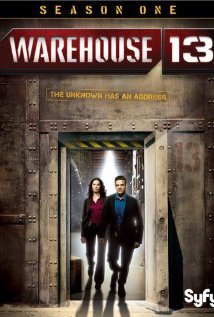
Warehouse 13

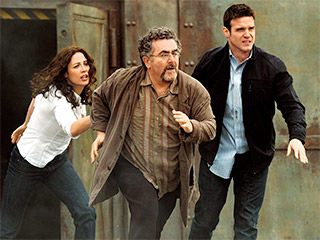
Recently I watched the first three seasons of the Syfy Channel’s Warehouse 13.  The upshot is that it’s fun and entertaining, but not necessarily something that will age very well or be particularly remembered.

There are two obvious shows to reference against: Bones and, of course, The X-Files.  In general the show seems aimed at a slightly younger audience than both.  It’s not nearly as dark and serious as X-Files mostly was.  With the exception of a few weird jokes late in the third season that stick out quite a bit, Warehouse also generally doesn’t have the occasional adult humor and mainstreamed stylish sexyness Bones tries to peddle at times.

It’s kind of funny to watch some of the forced comparisons with Bones in the first couple episodes.  Pete, the lead male character, comes across an awful lot like an even goofier Booth.  They even look extremely similar.  The tone is similar to Bones but without all the blood and unnecessary gross bits.  However, somewhat counter-intuitively, I actually find Warehouse a lot more coherent.  Bones to me never manages to strike a consistent tone between fantastical goofyness and serious crime drama.  By being rooted in precisely that fantastical goofyness, Warehouse actually works better around the viewers’ suspension of disbelief than Bones and a lot of high faux-science procedurals.

The production pitch is super obvious: Take the last scene from Indiana Jones: Raiders of the Lost Ark, and build a whole show around it. Dunnnzo!

Cue the Bond theme!

Unfortunately, I would say that Warehouse fairly quickly falls into the same trap that The X-Files continually danced around as it went forward, and eventually more or less fell into: Over-emphasis on long term story arc episodes at the cost of lighter, more fun and comprehensible one-shots.  My impression of Warehouse after the second season was actually fairly high.  Definitely a light show, but fun and going somewhere.  That momentum however really got dragged down in the third season by a steady stream of new characters, unnecessary webs of character relationships and family backgrounds, and an increasingly byzantine overarching story arc—all the same problems of complexity and weight that really plagued X-Files, though admittedly its true strength was the long-term development and complexity of the relationship between Mulder and Scully.  It’s a delicate line.  Warehouse has a good start on building up a bunch of interesting relationships, but I think launched the plot into the deep end a bit early.

On the upside, the show features a good number of solid female characters.  Myka, the female lead, is a bit stereotypical: The organized, controlled and controlling one who’s always just on the edge of emotionally cracking.  Otherwise though they’re pretty good.  Claudia is the most technologically savvy character on the show.  Mrs Frederick is both the consummate boss and fount of wisdom.  H.G. (Helena) Wells is a convincing and interesting super villain, and an interesting spin on a historical science fiction touchstone.  Leena’s new age trippyness I don’t find particularly compelling but the character’s not terrible when not being used for boob jokes.

Ooohmygod, they’ve got cookies! Cookies!

As an interesting design point, through the first season and a quarter or so the show has a somewhat unusual triple plot structure.  Most TV shows, especially those with an hour long format, run an A plot and a B sub-plot.  Until it settles down a bit in the second season, Warehouse often runs an A, B, and C sub-plot, where the A line is about the artifact du jour, the B line about some personal matter or relationship development among Myka and Pete, and the C line some near catastrophe in the warehouse occupying Artie (their boss) and Claudia.  These C plots are actually not too annoying and it’s an interesting way to build up the office and tech oriented Artie and Claudia characters before they become more mobile and active in the main plotlines.

“Look, don’t mess with me, I’m having a bad century.”

For what it’s worth, Warehouse is set in the same Syfy universe as Eureka (which I haven’t seen) and Alphas, which I’ve found pretty decent so far.  The tie-ins with Eureka are overt, with characters, gadgets, and companies appearing in both.  Connections with Alphas are a lot more implicit at the moment.  For example, Warehouse‘s third season character Steve is clearly some kind of Alpha though never explicitly labelled as such, and I would argue Claudia and several other characters show Alpha tendencies as well.  It’s a little fun trying to gauge which of Warehouse or Alphas has more budget.  I would guess Warehouse, given that it has a lot more setting variety, more gizmos, and actually a fair number of recognizable sci-fi actors.  However, I think Alphas is a lot more slick, the relatively more subtle and serious tone of the special effects making them seem more polished.  More importantly, the themes in Alphas seem a good bit more mature and deeper.

“Really? I will destroy you, and not even notice.”

“Listen, just because I was thown in here to compromise between being not-quite jailbait for all the sci-fi dudes, but still young and goofy enough for all the teenage dudettes to relate to, doesn’t mean I can’t kick your ass. Ohmygod, I’m, like, so screwed up, you know?!”

Overall though, Warehouse 13 is a reasonably solid, warmhearted and goofy little science fiction show.  It’s probably a bit light for anyone besides teenagers/young adults to really really dig into, but not so much as to be offputting or especially boring.  It’s also fairly obvious in nature and execution, and thus easy to have on in the background or to pick up off and on.  So, I recommend it for fans of the genre looking for some digested entertainment, just don’t expect too too much.

Finally, Artie, the lead agent, is from Philadelphia… and a curmudgeon.  Bonus points for realism!