40k Matched Play Armies Walkthrough

Questions about army list building in Warhammer 40,000 8th edition continue to come up as newcomers join the hobby and old heads return. So I’m going to write my explanation about detachments, Battle Forged, and so on here just one more time and then link to it in future conversations. Corrections and questions are welcome.

TL;DR

For Matched Play, the most common 40k 8e format, armies must be organized into detachments and all units across the entire army must have at least one faction keyword in common (e.g., Imperium). Additional buffs are available for detachments (not armies) drawn from single codexes or factions (e.g., Space Marine chapters).
Background

My impression is that most players are generally using the Matched Play format, as opposed to Open Play, Narrative, or something else ad hoc. I could be wrong about that in general, but it’s certainly true of pickup play around my local scene (Redcap’s Corner) and all the tournaments I have seen (and run). So the default is that you’re selecting armies by points, not power levels, and adhering to Matched Play format.

Hampering newcomers in hunting down rules is that Matched Play is actually more restrictive than Battle Forged. Many people implicitly assume Battle Forged is more fluffy and limited. That’s not the case. Matched Play is a subset of Battle Forged, not the other way around. Competition-oriented Matched Play and some newer rules additions from the codexes and upcoming Chapter Approved supplement actually do more to encourage armies more similar to traditional Force Org Chart, no allies, old-school 40k. Battle Forged by itself is more open.

Battle Forged

Matched Play requires that your armies be Battle Forged (main rulebook page 214, top left). Battle Forged requires your entire army to be organized into one or more detachments (main rulebook page 240, top left).
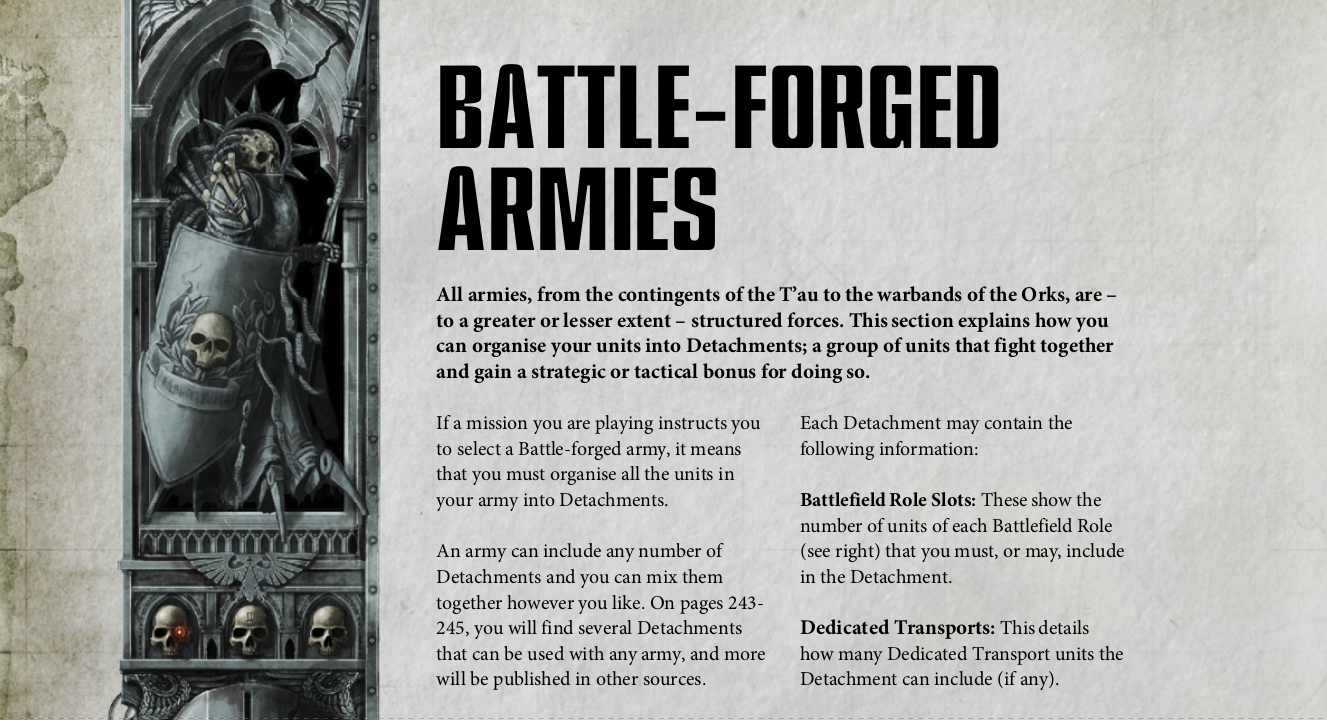
Beginning of the Battle Forged rules.

Detachments in theory are wide open, you can put any mix of units in there. However, in practice all of the units within a detachment must share at least one keyword. All of the detachments in the main rulebook such as Patrol, Battalion, Outrider, and so on either explicitly impose that restriction or are limited to a single unit. The only exception is the Fortification Network, which permits multiple fortifications with no faction restriction. There are some faction specific fortifications out right now, such as the Tau Tidewall, but most published so far are Unaligned (the commonly seen ones are all in Index Imperium 2), and this is mostly a small side point anyway.

Unless I’ve missed something, no other detachments have been published or rumored. So, in the future some supplement or such could perhaps have a detachment that permitted you to include Orks and Imperial Guard within a single detachment. However, you cannot do that within any of the detachments that currently exist because those units do not share any faction keywords. What you can do though is, for example, make up a detachment of Imperial Guard and Ultramarines units, because those all share at least one faction keyword (Imperium).
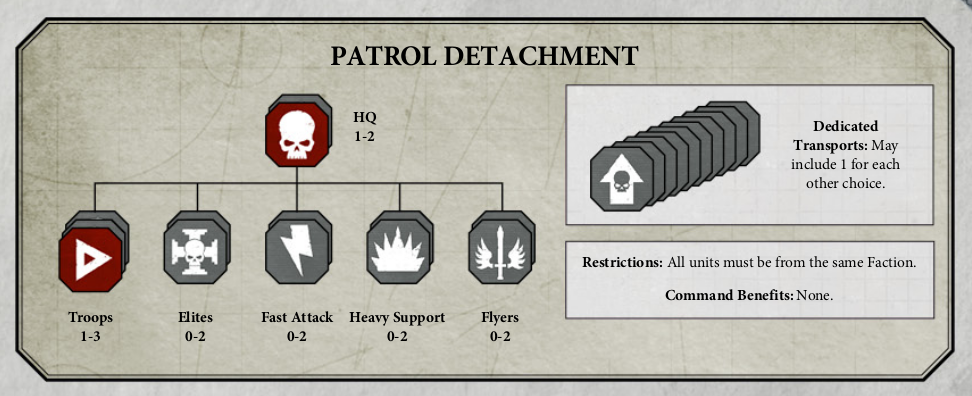
The Patrol detachment.

In addition, under Battle Forged rules alone, your army could straddle factions across multiple detachments. You could, for example, make up a Battle Forged army that had two detachments of Imperial Guard and one of Orks. There are no rules for Battle Forged armies linking the detachments.

Matched Play

However, Matched Play prohibits that by imposing such a linkage. Matched Play requires that armies be Battle Forged and that all units have at least one faction keyword in common (main rulebook page 214, under “Army Faction”).

So, in a tournament or pickup play using Matched Play rules, you could not field an army with detachments of Imperial Guard and Orks even though it was Battle Forged. You can however still mix Imperial Guard and Ultramarines units within and across detachments, because those all share at least one keyword.
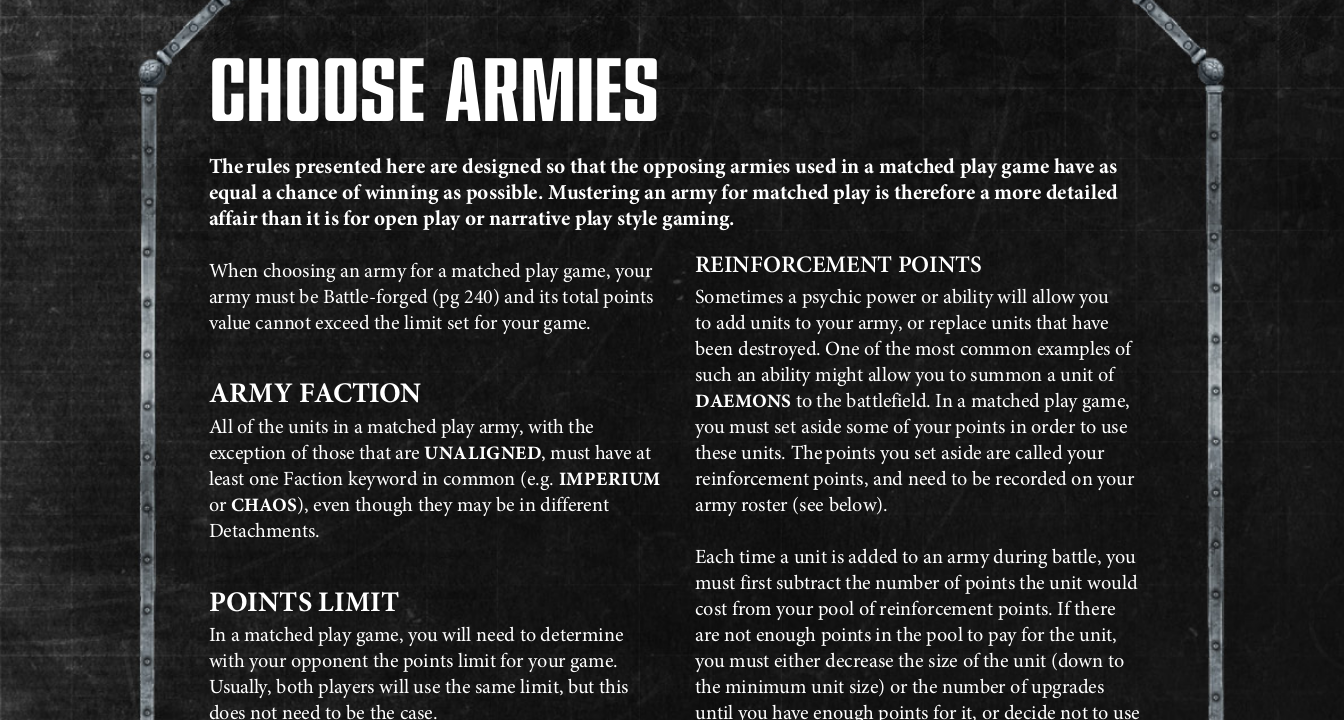
Beginning of Matched Play rules.

Faction Buffs

New rules from the codexes released to date as well as the upcoming Chapter Approved supplement however encourage—but do not require—detachments drawn from a single faction by offering at least four types of buffs for doing so.

Objective Secured

The codexes seen so far all have rules, such as the Space Marines’ Defenders of Humanity, that give a scoped but important buff to models in a detachment comprised solely of units from that codex: They trump other models for control of objectives. The Chapter Approved supplement will provide a similar rule, Objective Secured, for all the factions that still only have Indexes. Most events seem to be adopting this and the other updates to Matched Play from this supplement that have been officially previewed. There’s a reason GW rushed out these rules previews just in time for the first really large 40k event under 8th edition (NOVA): They address a number of balance issues, particularly as the codexes roll out.
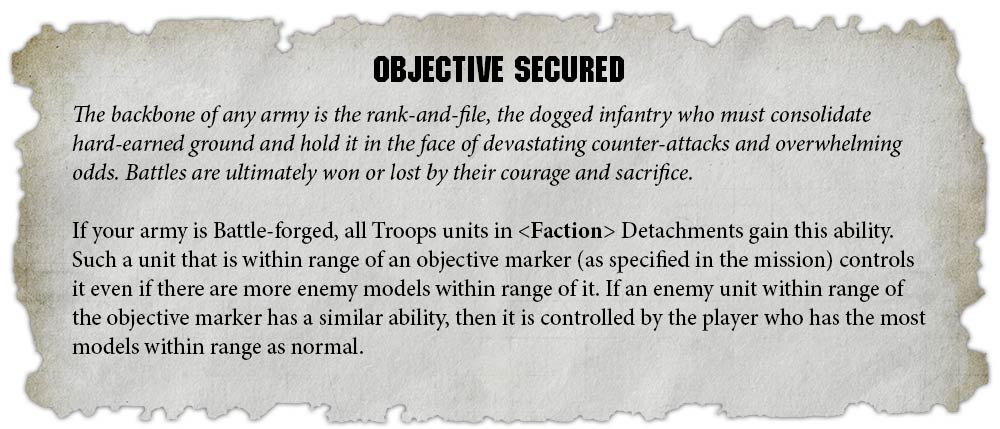
Preview of Objective Secured rule from the upcoming Chapter Approved.

Stratagems

Similarly, codex stratagems are unlocked by fielding at least one detachment comprised solely of units from that codex. So a detachment made up of Imperial Guard and Space Marines would be Battle Forged, share a keyword, and be legal in Matched Play, but by itself it would not have access to either of those codexes’ stratagems. That’s a severe penalty for mixing the factions given the utility of some of those, so it’s another strong incentive to field uniform detachments.

Chapter Tactics

All of the codexes released or previewed to date have also granted additional unique benefits to detachments comprised solely of particular factions: Space Marine detachments made up of a single chapter receive an associated Chapter Tactic, Grey Knights have a Chapter Tactic in Brotherhood of Psykers, and Chaos Space Marine legions all have their own benefits. Future codexes will grant similar unique benefits to detachments made up of specific regiments, dynasties, forge worlds, clans, etc..
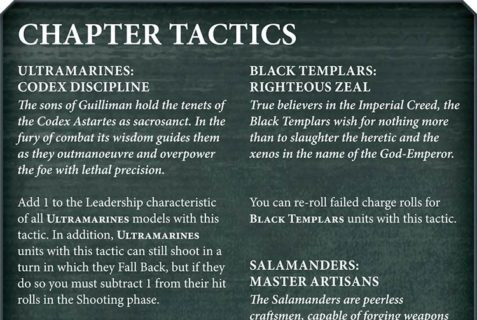
Some of the Space Marines’ Chapter Tactics.

Units

Finally, most unit special abilities affecting other units are also compatible only with the most specific factions. Transports in the mainline indexes and codexes can only embark units drawn from the same chapter or that codex’s equivalent. Captains, honor guards, ancients, and similar generate aura buffs only applicable to units and models from their specific chapter or equivalent. There are some notable exceptions, such as Guilliman, who provides an aura at the Imperium level. But in general while detachments made of various factions under an umbrella faction are valid in Matched Play, their units will be limited in how they interoperate and support each other.

In some sense this incentive is not very strong. You might only be planning on those units interacting with a few other units anyway. But unlike the Objective Secured and Chapter Tactics type buffs it is diffused across the entire army, creating a soft linkage between detachments: Sure would be a bummer if at some point in a game a unit in one detachment really needed to embark a transport or receive some buff from a unit in another detachment but couldn’t because they were of different factions (detachment boundaries alone do not impair such abilities). So the tighter faction scoping of most unit abilities in this edition also gently encourages focusing on one or a limited number of factions, even between detachments.

Fluff

By and large though the explicit faction-focus benefits so far are primarily encouraging uniform detachments, not armies. You could still mix factions between detachments, provided they all have at least one shared faction keyword, and get these buffs. So, as long as our example Imperial Guard and Ultramarines army was organized into detachments each with uniform faction, they would all have Objective Secured or Defenders of Humanity respectively, access to their stratagems, the Ultramarines would get their Chapter Tactic, and when their codex arrives the Imperial Guard will get some benefit associated with the chosen regiment.

Matched Play rules therefore impose basic requirements prohibiting very unfluffy combinations. You can’t field Orks and Imperial Guard together. But within a larger alliance such as Imperium or Chaos you have a great deal of flexibility, certainly across an army and even within detachments. However, there are multiple strong incentives for focusing detachments at least on particular specific factions. Unit level interactions and combos are also much more constrained. Taking all of these rules together, in 8th edition you won’t see anything nearly as crazy as the allies permitted in the recent prior editions, and many armies will in fact be very traditional.

Limited Detachments

One last general note is that most events are limiting the number of detachments that may be taken. Matched Play provides a table of suggestions (main rulebook bottom of page 214) which have been widely adopted. So at the new standards of 1500 or 2000 points, armies are generally restricted to 3 detachments.
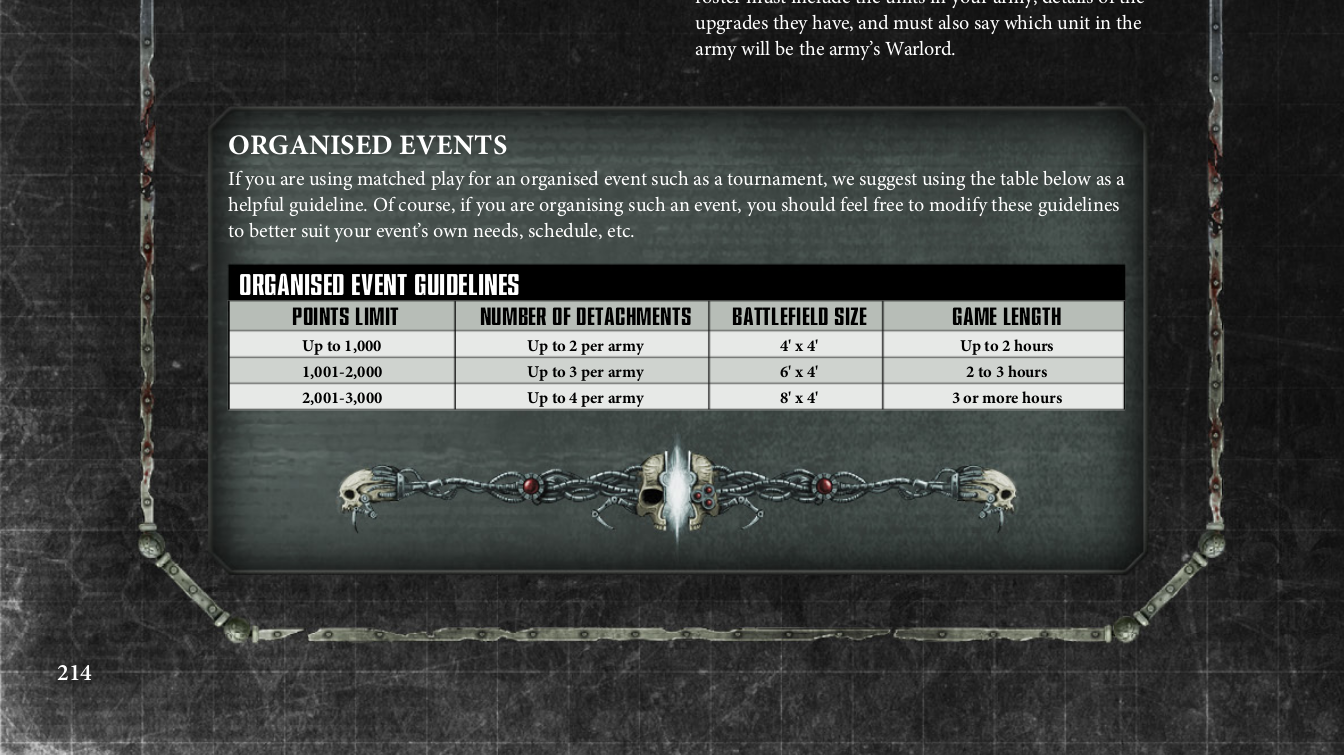
Suggested detachment count limits.

Conclusion

In sum, the rules for allies and army organization in Matched Play are somewhat confusingly presented as they’re located in a variety of places throughout the 40k main rulebook. But in practice they’re pretty simple: Armies must be made up of detachments, every unit across an army must be from the same general faction, and there are buffs for detachments selected from a single specific faction.

Footnote

It is a detailed rules design topic not especially applicable to actually playing, but this post discusses duplication and ambiguity problems in the rules around Objective Secured and Space Marine Detachment.

2017 NOVA 40k Trios

Colin and I headed up the NOVA 40k Trios Team Tournament again this year. We had 21 teams for 63 players, up from 18 teams last year. Trios features a somewhat unique format, in which teams of three play a doubles game and an individual game against an opposing team each round. It really only works at a large event like NOVA because of how many players are needed to have a good number of teams, but it works really well there. It’s a great way to start off the convention because you spend the whole first day hanging out and playing with friends.

This year seemed to be a big success, continuing on from last year’s well regarded event overhaul. As mostly expected, Warhammer 40,000 8th Edition seems to be holding up well to large competitions. We had extremely few rules questions come up and they were all easy to resolve. There were of course some powerful units kicking around, but no grumbling about specific units and armies at anything approaching the scale of last year. Games Workshop also again donated really awesome trophies for our top team. In addition, something I especially appreciated as someone who takes a lot of photos and spends almost literally 4 straight days at NOVA staring at games, TABLEWAR donated F.A.T. Mats to cover all the tables. Combined with numerous excellently crafted armies, the visual appeal of all the games was really high this year.

Many more photos from the event are available in the gallery here.

2017 NOVA 40k Trios underway!

Missions

We ran our three most traditional missions, battle tested now over many events:

  • Open Ground: Controlling markers, choosing to score continuously or game end.
  • Slaughter Zone: Our take on Annihilation, using percentages of units killed.
  • Battlefield: Players choose from several primary objectives to either hold specific markers, kill enemy units, or preserve their own units.

Each of those missions also has a selection of secondary objectives, enabling players to either double down on the primary objective style or go for something else. For example, an army good at holding ground might choose a secondary to claim terrain pieces in addition to the objective markers, while an army better at killing units might choose a kill points secondary objective.

In addition, special to the 40k Trios and our local annual Tournament of Blood, each player is working toward a set of ten Warlord Achievements each round. These award the head of the army for personally capturing objectives or slaying enemies.

The full event primer with missions and details is available as a PDF here.

Rough Riders are apparently a thing now, there were several armies of them!

Results

NOVA 40k Trios awards five titles:

  • Renaissance Trios: Overall winners across battle points, sportsmanship, craftsmanship, and theme.
  • Strategists: The team with the most wins and then battle points.
  • Artists: Best painted team as judged by NOVA/Capital Palette painting judges.
  • Storytellers: The most original and best presented story of why a team’s forces are fighting together.
  • Warmaster: The individual who scored the most Warlord Achievements.

Our winners this year:

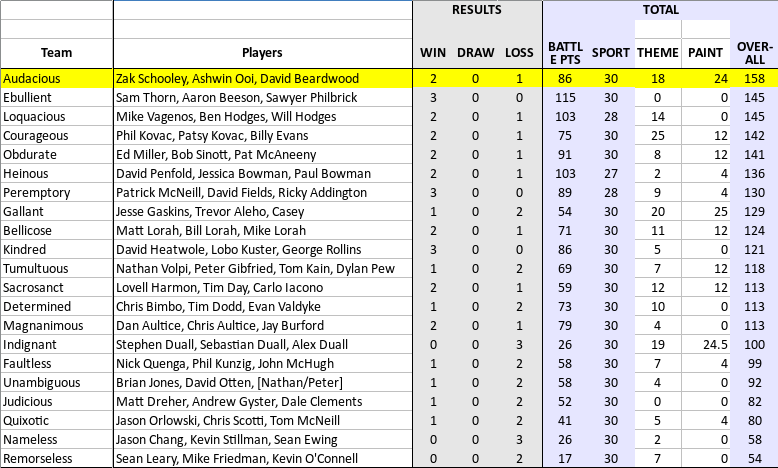
  • Renaissance: Zac Schooley, Ashwin Ooi, David Beardwood.
  • Strategists: Sam Thorn, Aaron Beeson, Sawyer Philbrick
  • Artists: Jesse Gaskins, Trevor Aleho, Casey ?
  • Storytellers: Phil Kovac, Patsy Kovac, Billy Evans
  • Warmaster: Sawyer Philbruck

Full results are available as either XLSX or PDF.

Final overall standings.

Final overall standings.

Everyone, even the simplest soldier, has at least their life to offer the Emperor.

Theme

Lots of teams really get into the narrative aspect of why their teams are fighting together, making extensive writeups and display boards. We very much enjoy seeing that effort each year, especially as it was our primary interest when we were Trios players. There were many great displays this year, so please check out the photo gallery. But four teams came up tops in our scoring matrix (detailed in the primer).

Team Audacious, our eventual overall winners, had an amazing, cohesive display of an Eldar force escorting Ultramarines through The Webway to reinforce Imperial Guard under Necron siege in their Ceresia Campaign background story.

Teams Gallant and Indignant, last year’s theme winners, again had an extensive writeup and display for their Liberation of Bellatain Prime storyline.

But our Storytellers title went to Team Courageous for their Crystal V and Hive Hyatt Prime storyline. You can read their introduction here. The competition was really close between all four of these teams, but what put Courageous ahead were three totally aligned factions and small details tying the armies and story together, like HQs having campaign shoulder pads shared across the armies.

This year’s event again though featured numerous incredible army displays in addition to these. More photos are in the gallery.

Next Year

Overall I think the NOVA 40k Trios is working well. Major changes for 2018 aren’t expected, mostly procedural tuning and the usual mission rotation and tweaking. However, a few larger changes come to mind.

One possible addition are small buffs to help the second player defend against a first turn onslaught. That needs more thought, testing, and consensus building as 8th edition continues to shake out, but it sure seems like among most players the first turn is perhaps overly strong. A return of tertiary points for killing Lords of War is also probable. We kept those in the Narrative this year but tested Trios without. We’ll probably also adjust Sudden Death and Boots on the Ground to also include Lords of War with the Fly keyword, or a similar ruling. Their technical exclusion from the errata for those rules came up in both 40k Trios and 40k Narrative, and I think goes against their intent and is probably inadvertent.
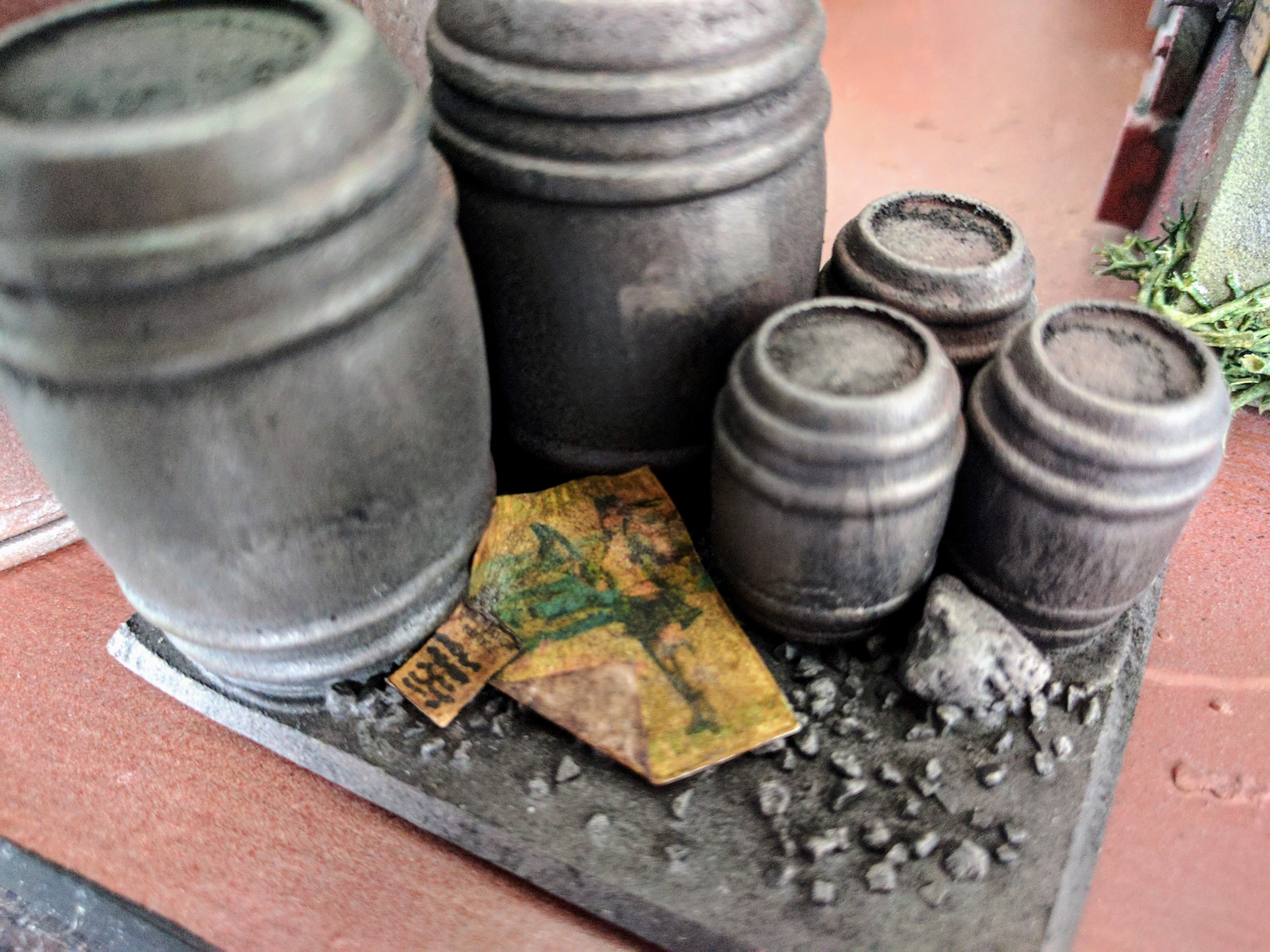
Another great army display, from Team Sacrosanct (CREW SHAKEN!).

Another great army display, from Team Sacrosanct (CREW SHAKEN!).

The most significant potential change on the docket right now is a very different slate of Warlord Achievements. Both years now the Warmaster title has gone to a player on the Strategists-winning team. To some extent that’s not surprising and maybe inevitable. However, the current set of achievements encourages that by being goals you generally want to attain anyway, like slaying the opposing Warlord. It would be interesting if the achievements were just enough off track that you had to make a stronger choice between playing toward the mission or the achievements. We’ve thought about this idea a fair amount and haven’t yet come up with anything which we didn’t think was either overly complex or too distracting from the main mission, but will put more thought into it. It would be great for this title to wind up landing in another team, much like how we’ve seen a good spread among the team titles.
These are all somewhat minor issues though. It was another great year for the 40k Trios, and I look forward to yet another in 2018. Don’t forget to check out all the other awesome armies in the gallery!

UPDATE: Greg Hess also has pictures up of the 40k Trios.

One of the team shirts, dispensing important advice.

Derelict Depot

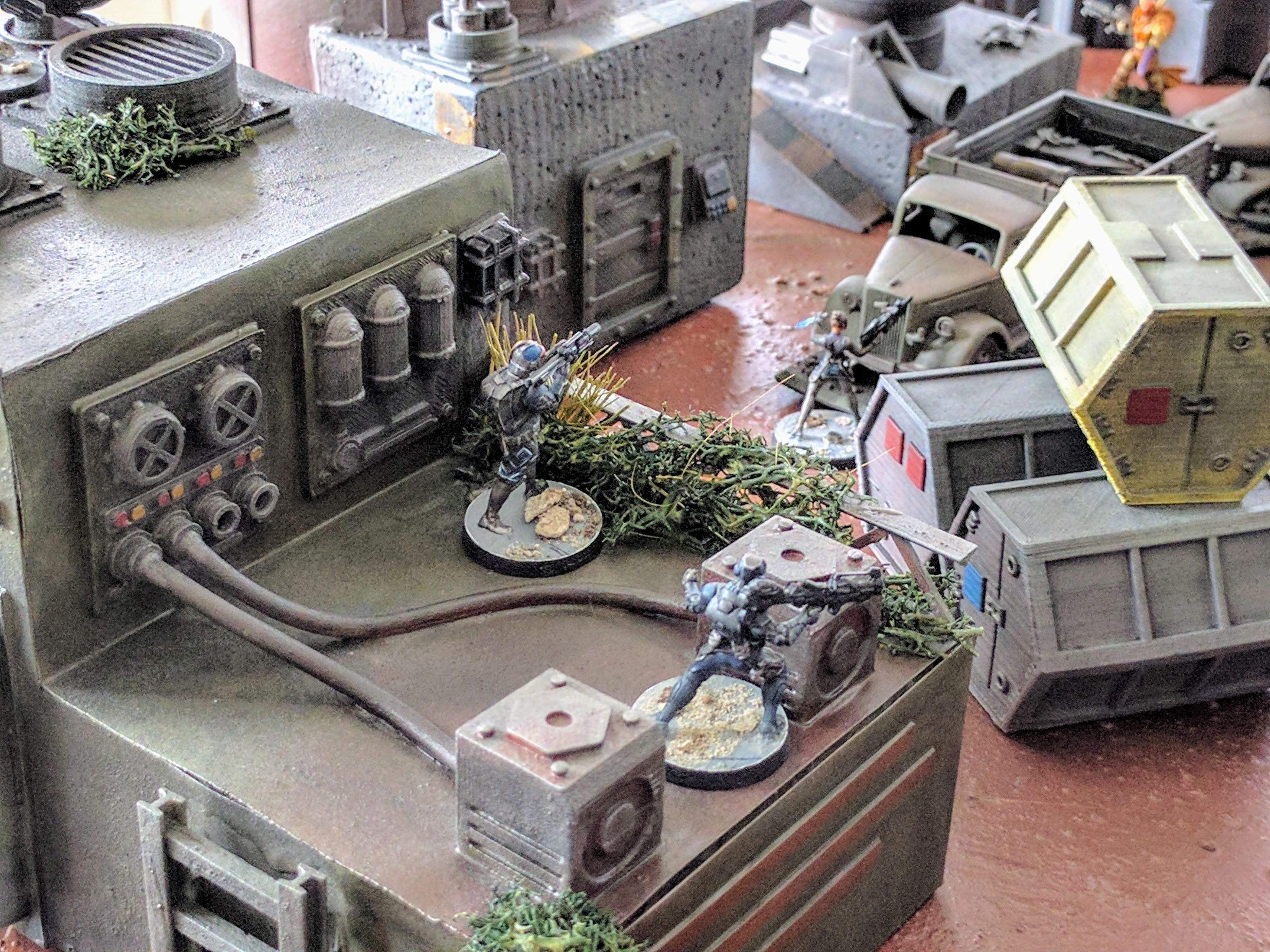
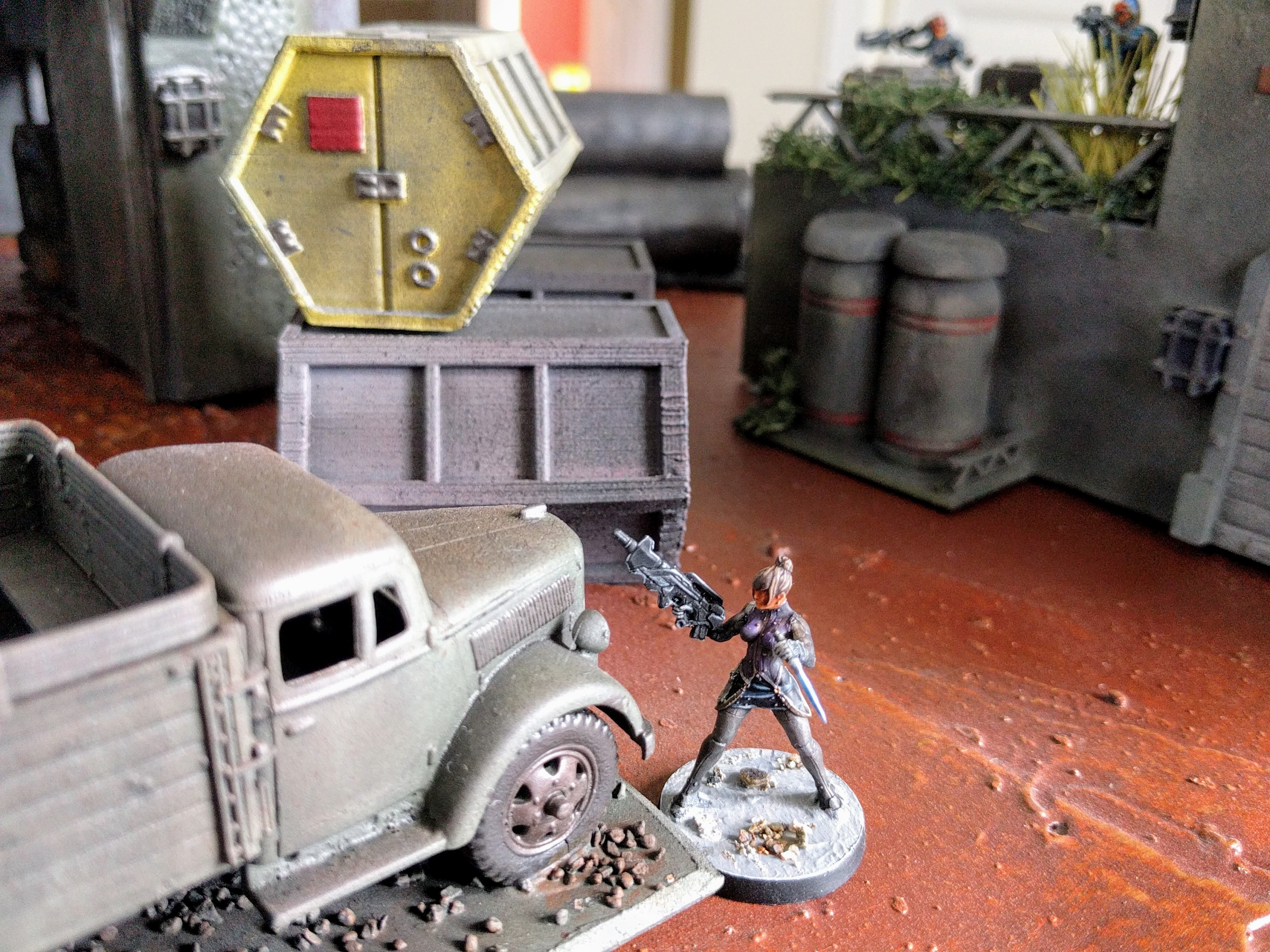
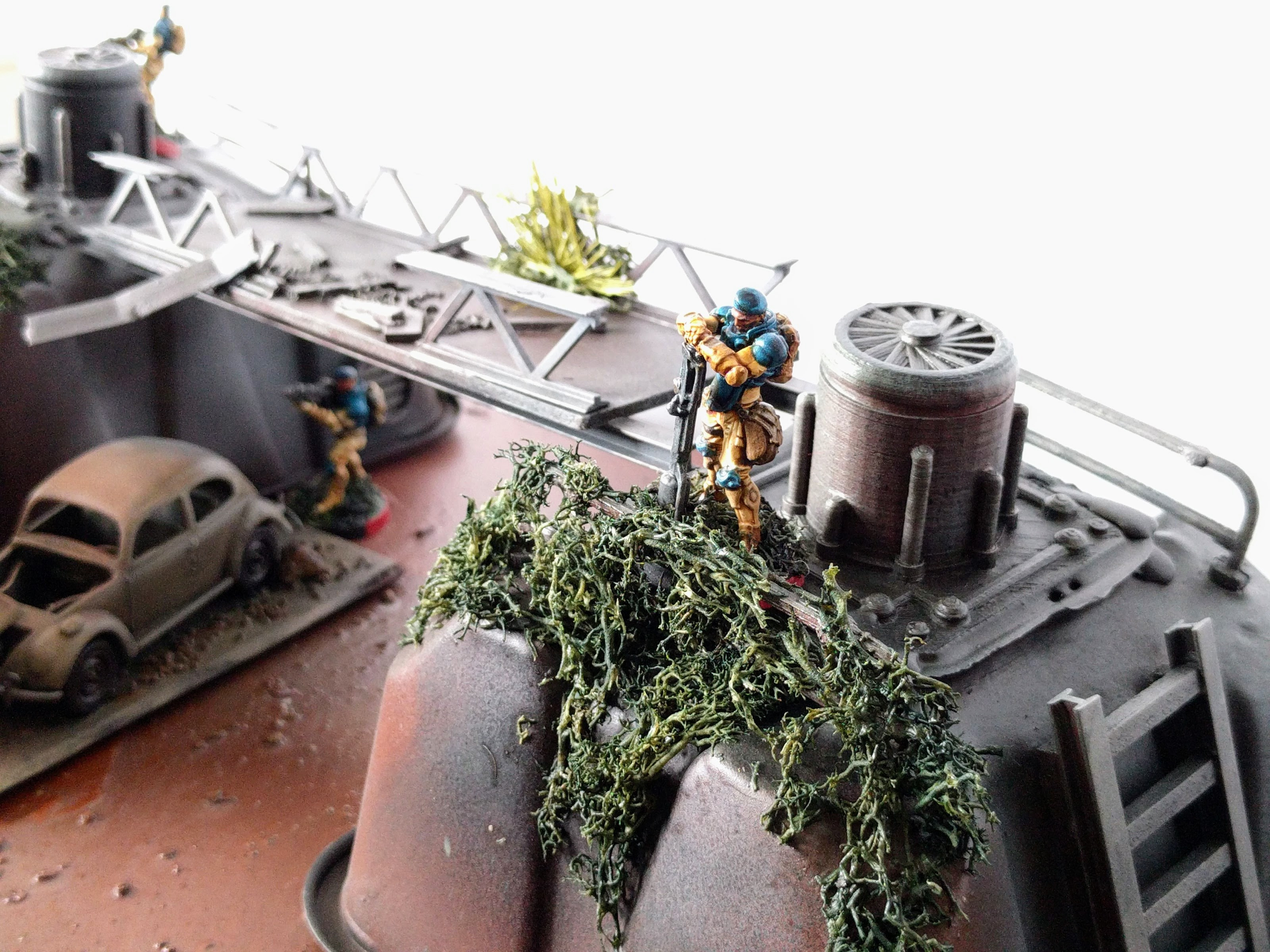
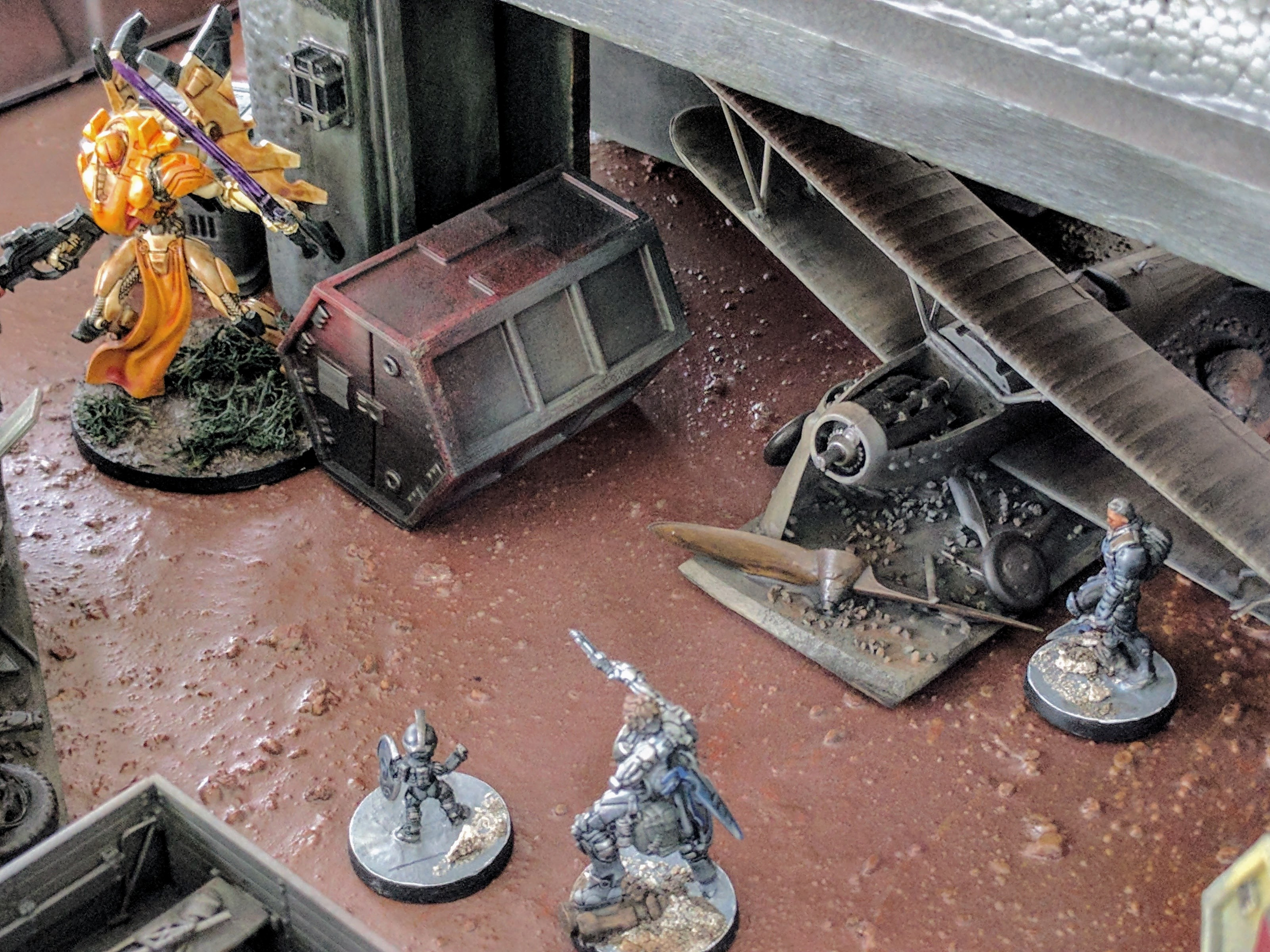
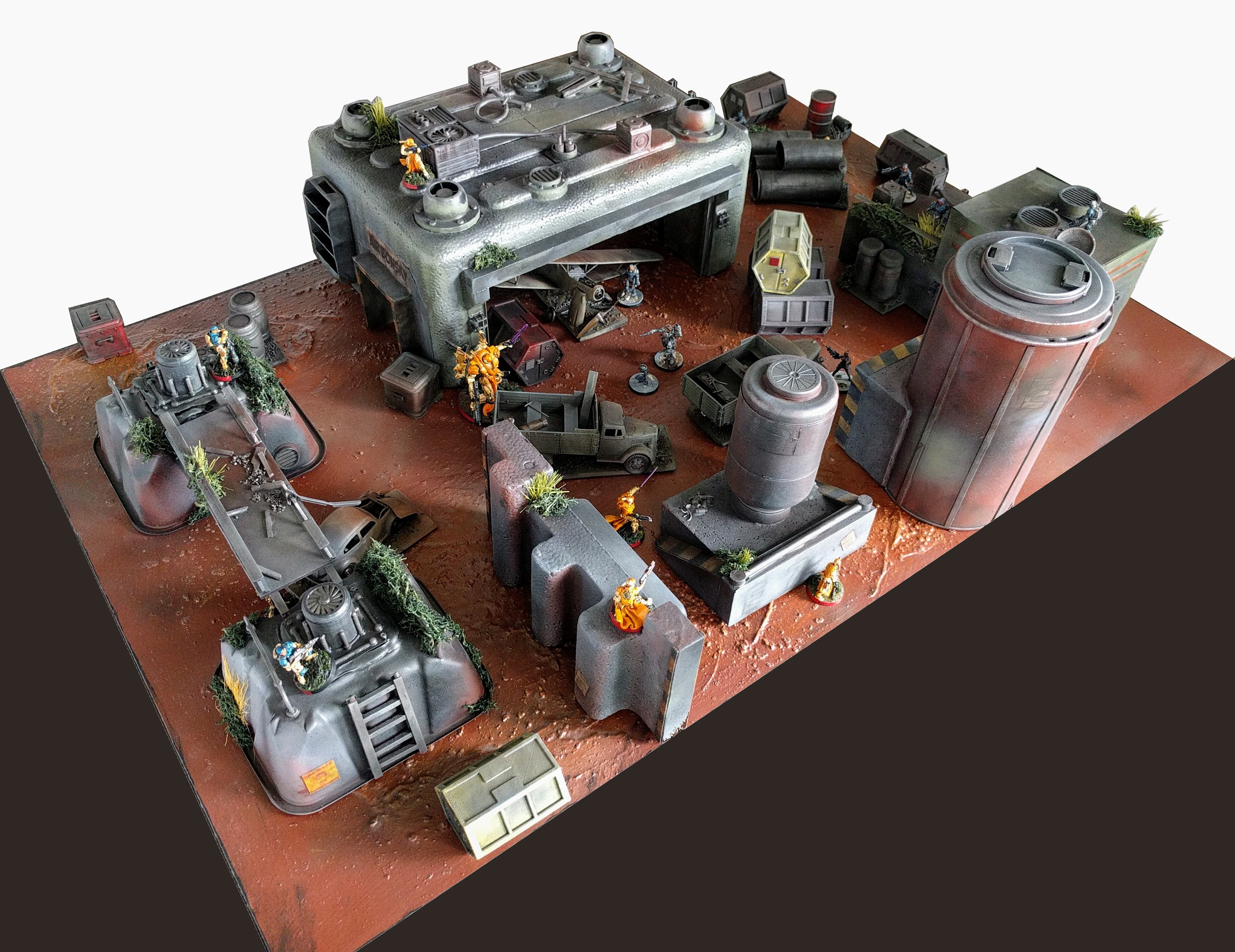
Battle breaks out amid the newly completed Derelict Depot!

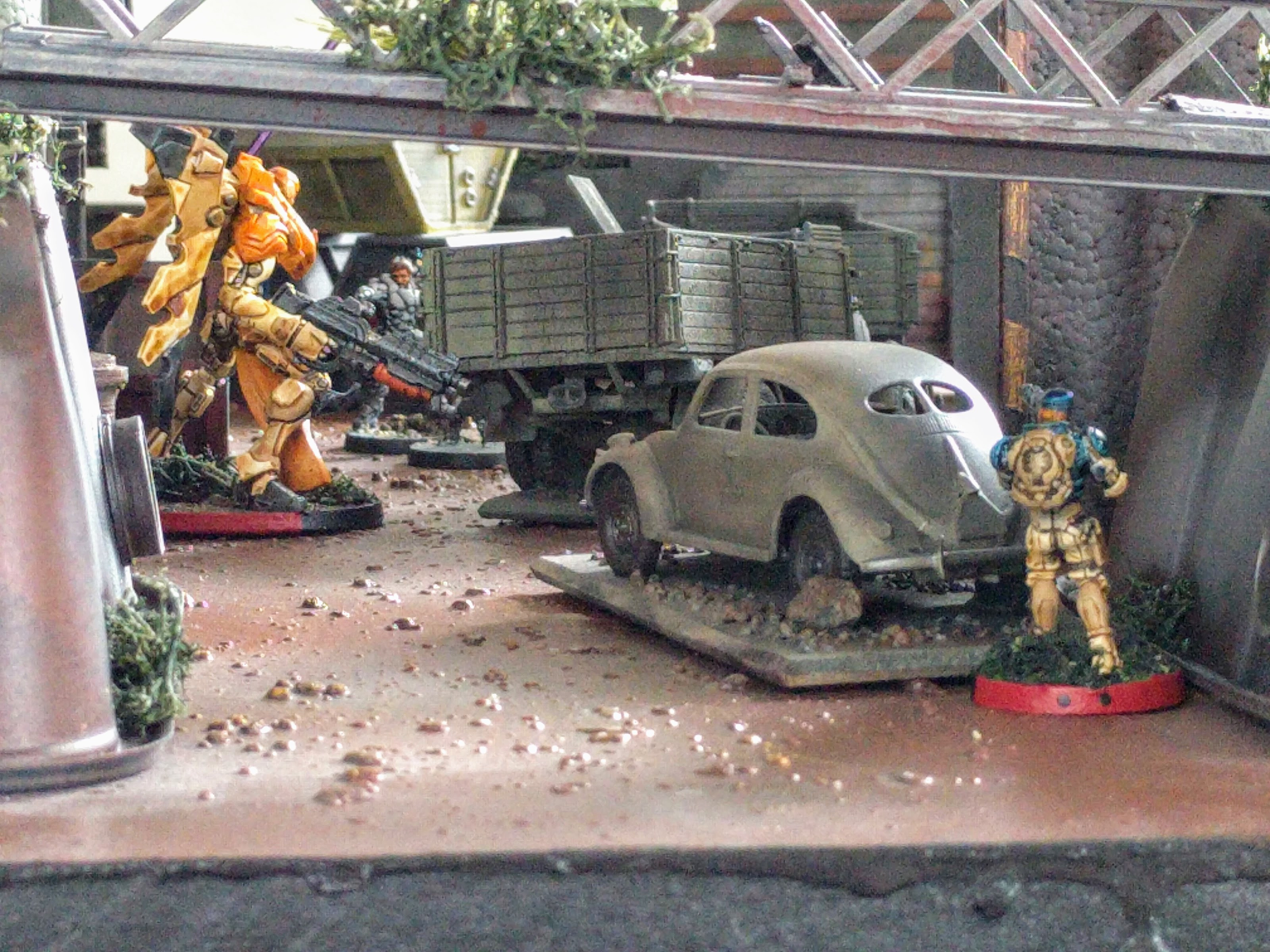
Advancing through the wreckage.

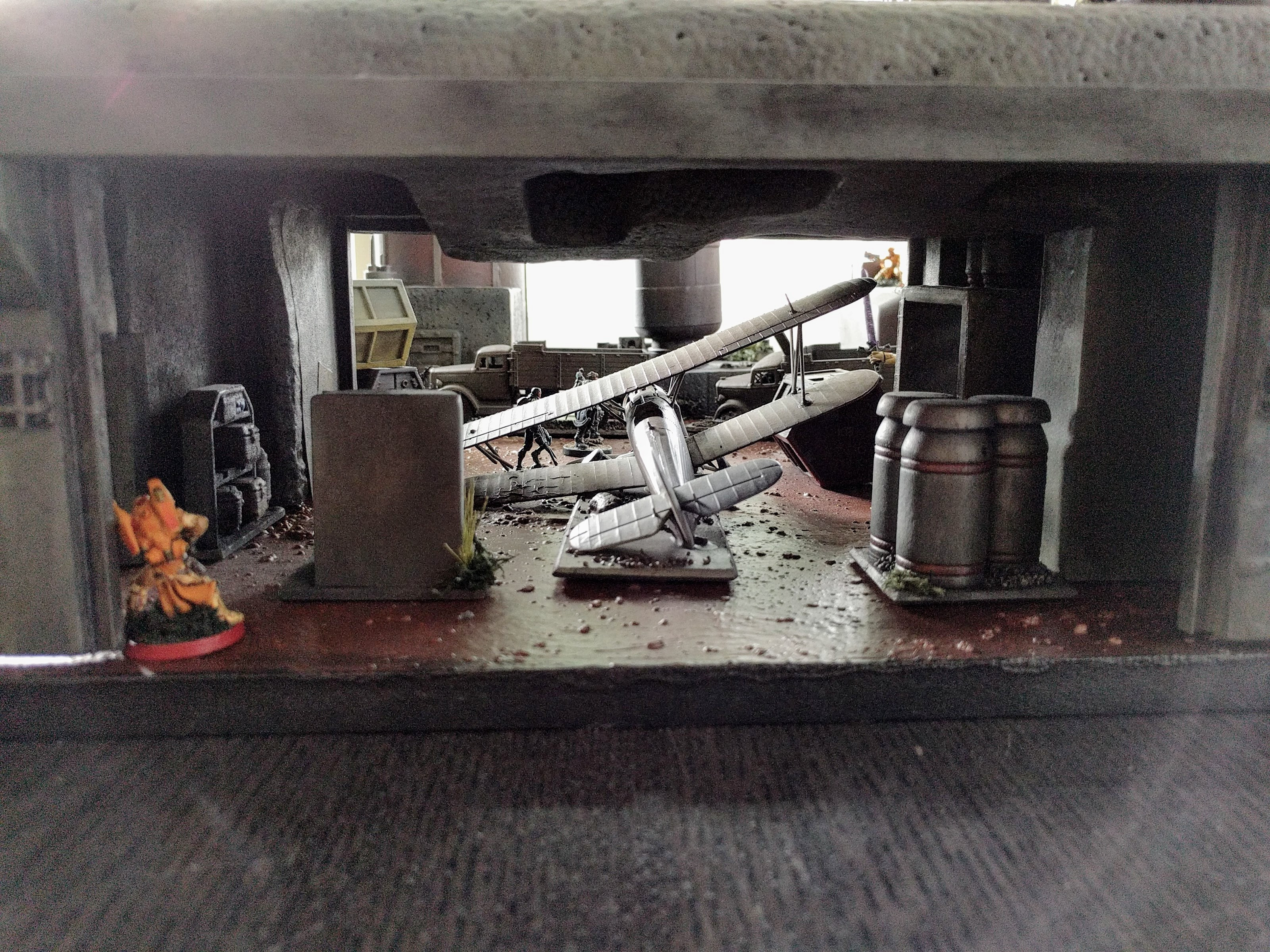
Looking out from the abandoned garage.

Lurking in the shadows.

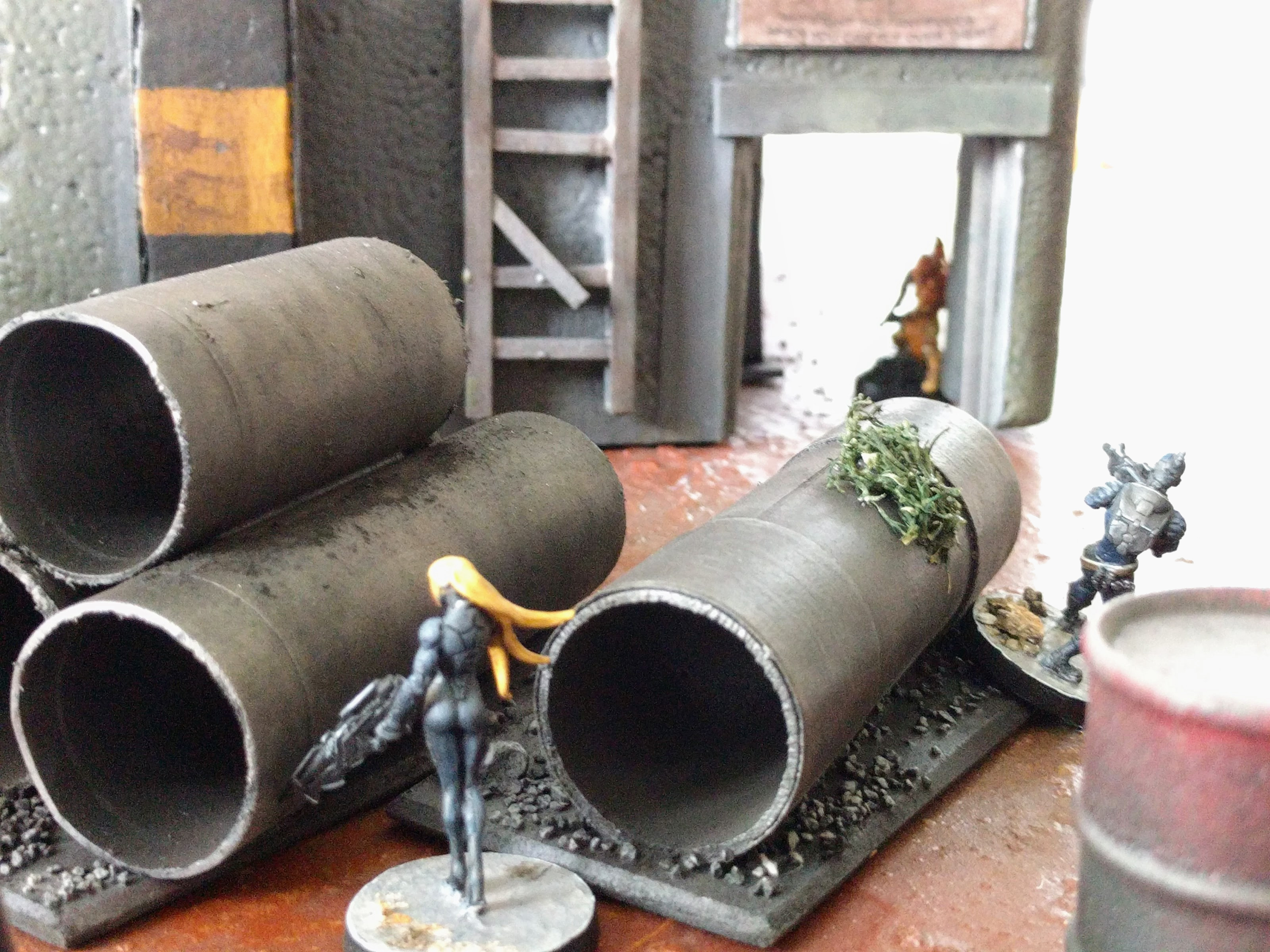
Moving through the scrapyard.

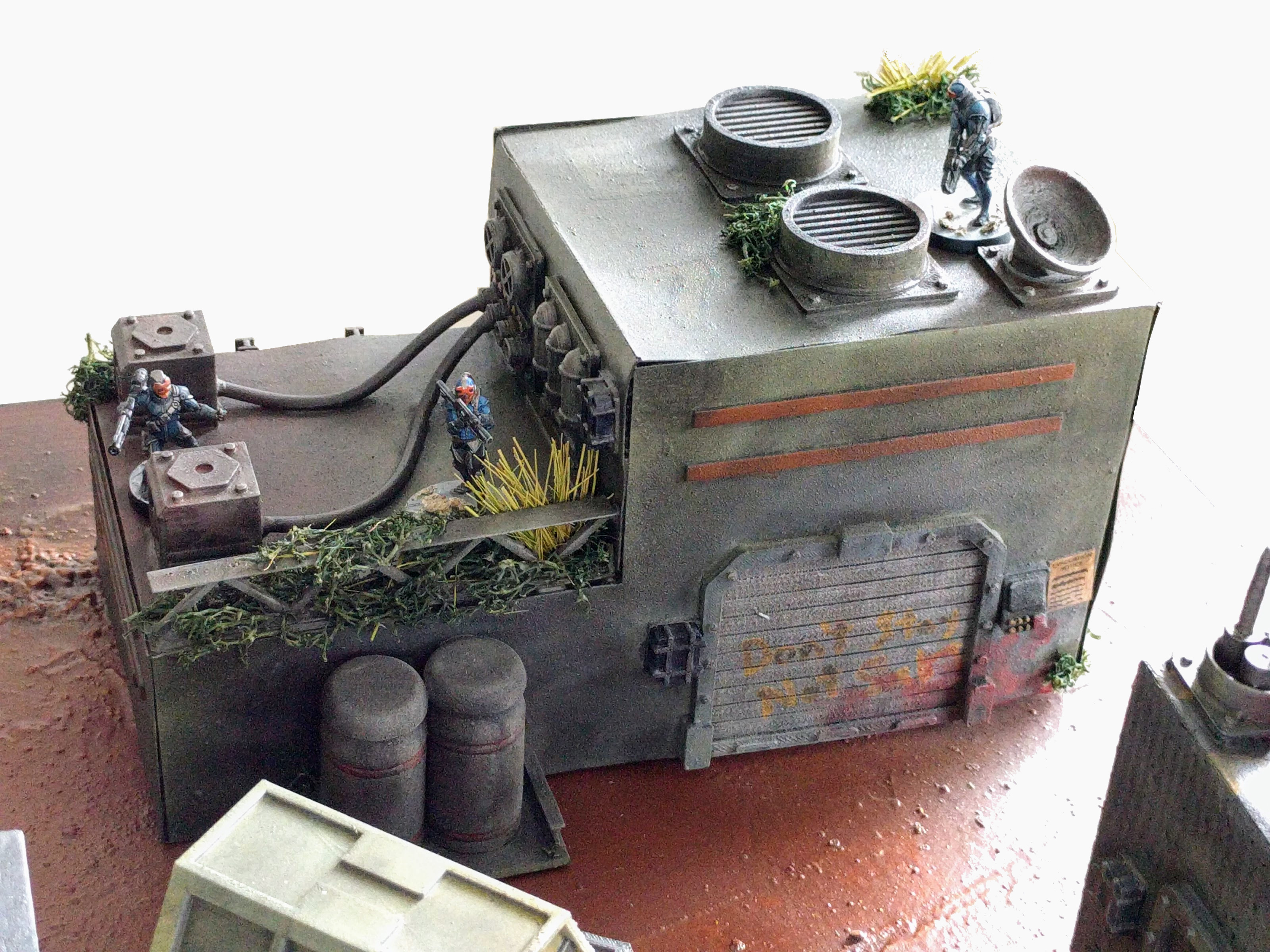
Garrisoning the mechanical building.

Scouting for trouble.

Overlooking the battle.

Showdown at the depot nexus!

Derelict Depot

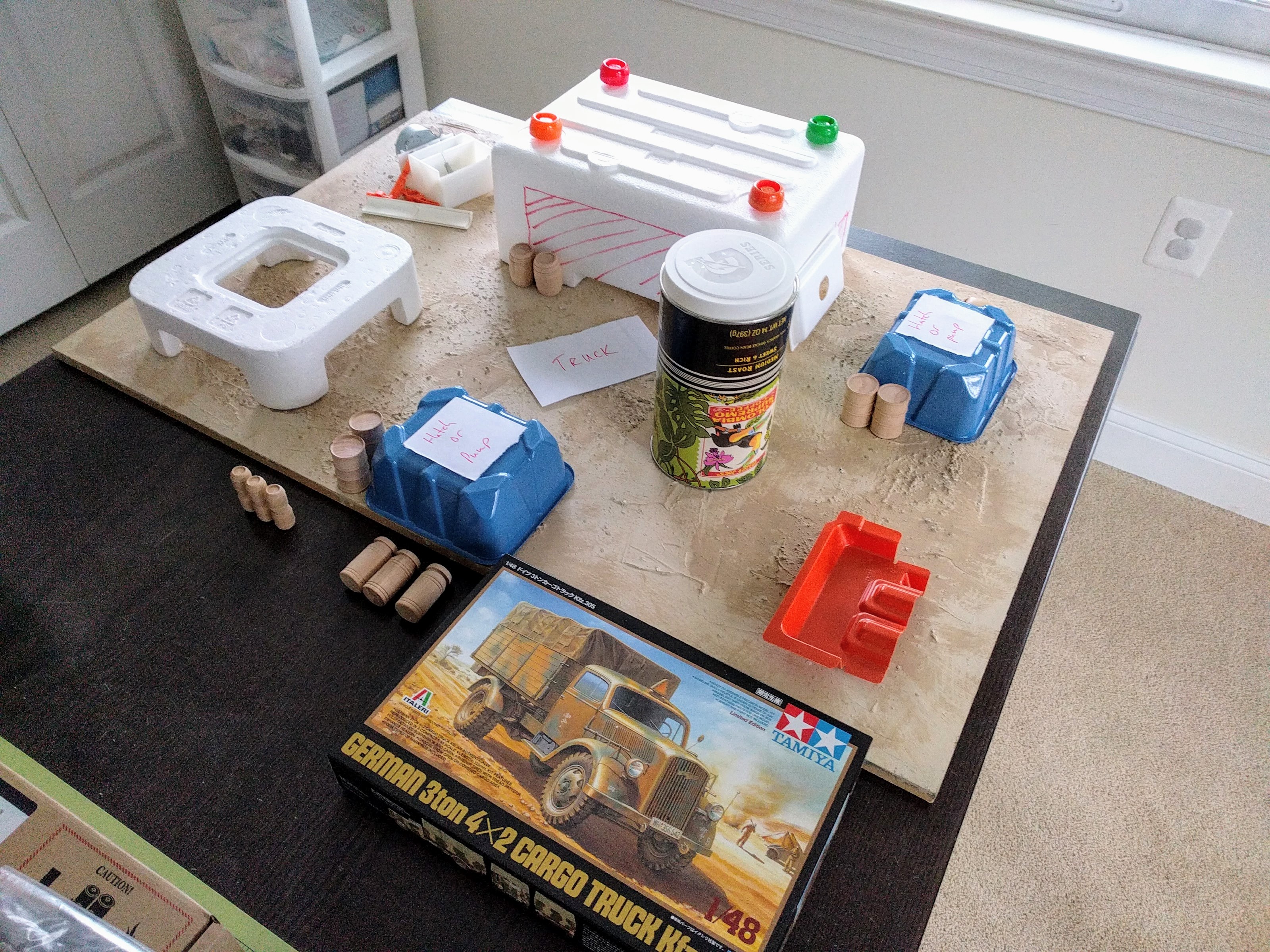
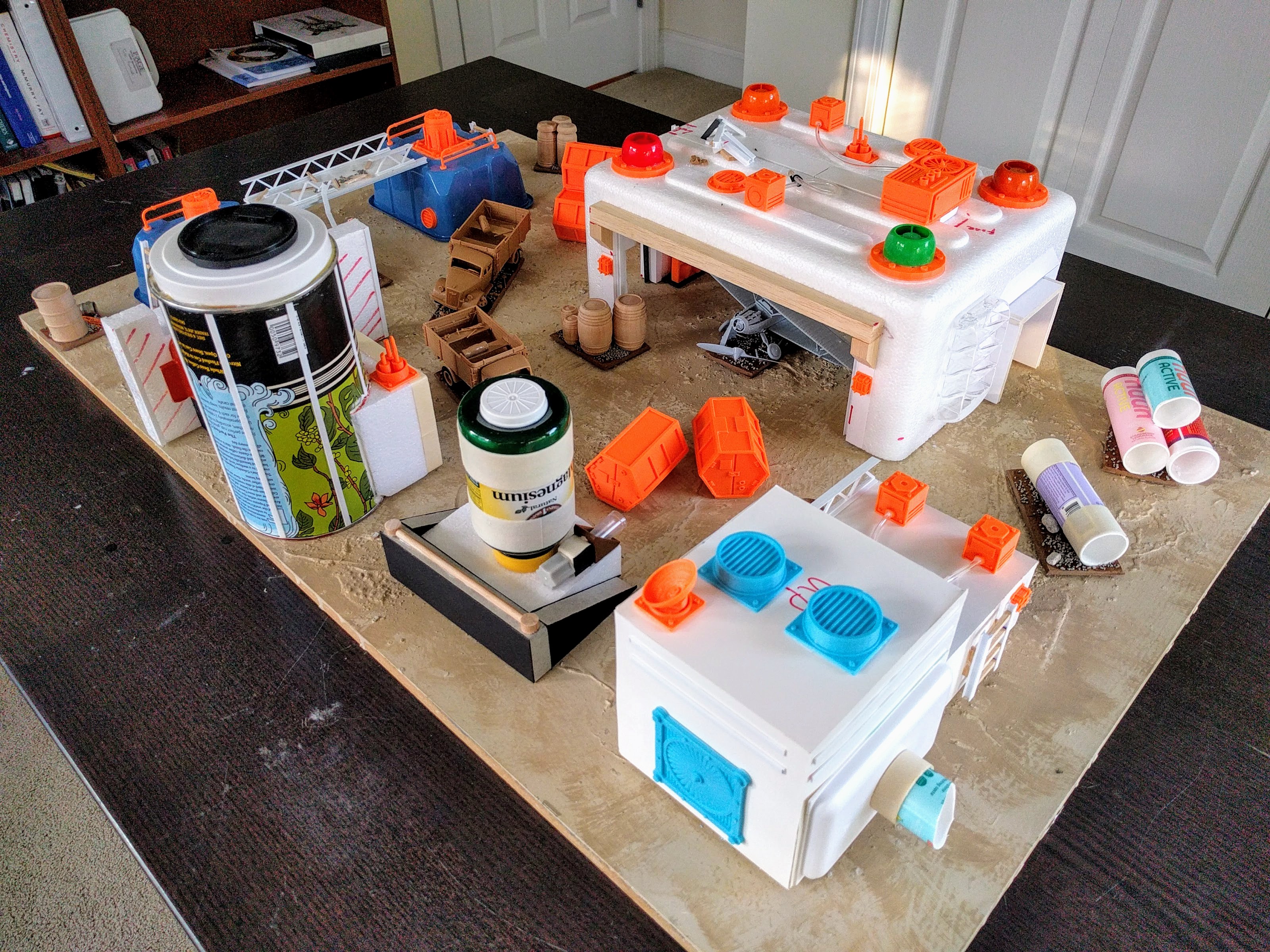
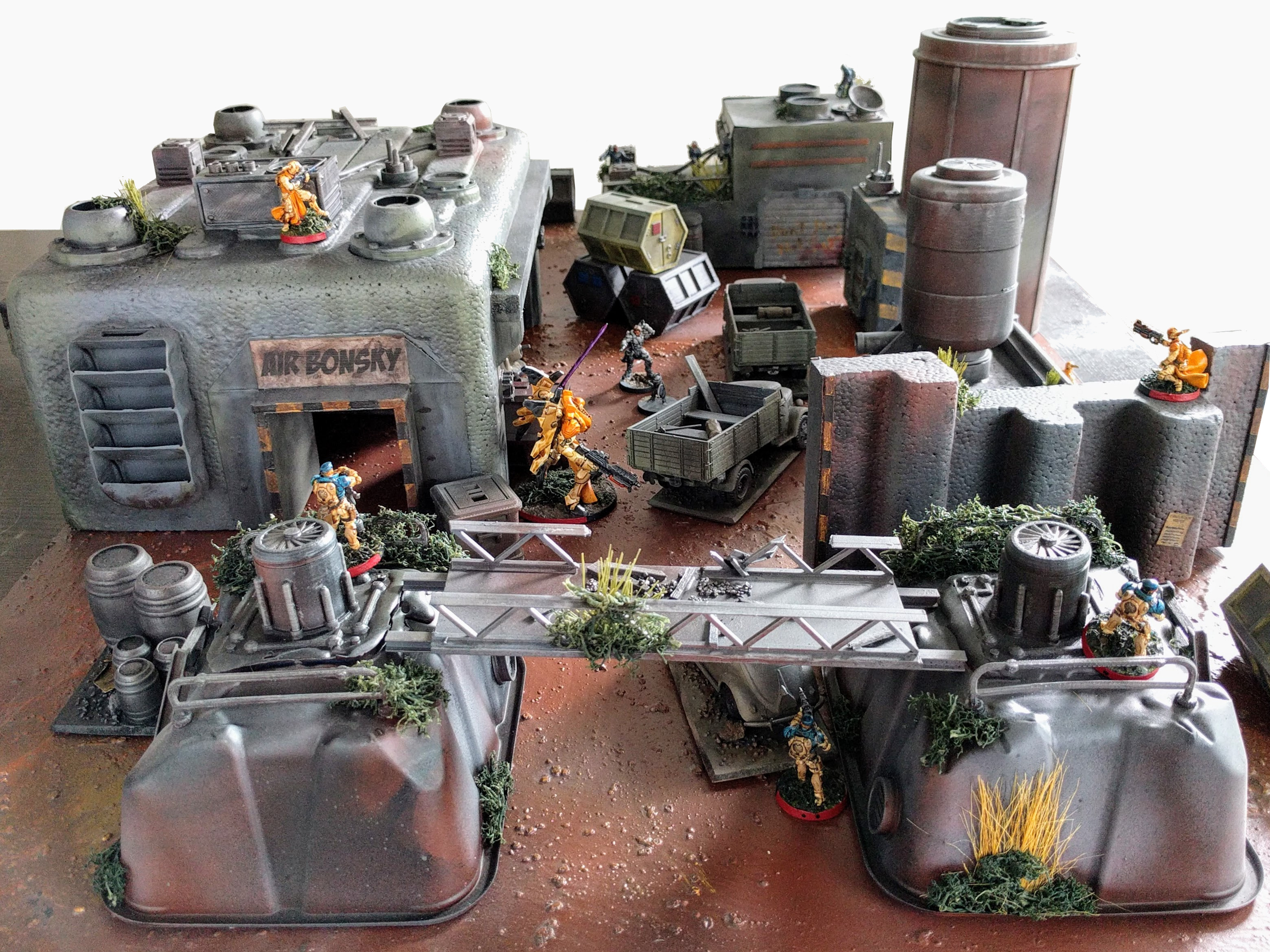
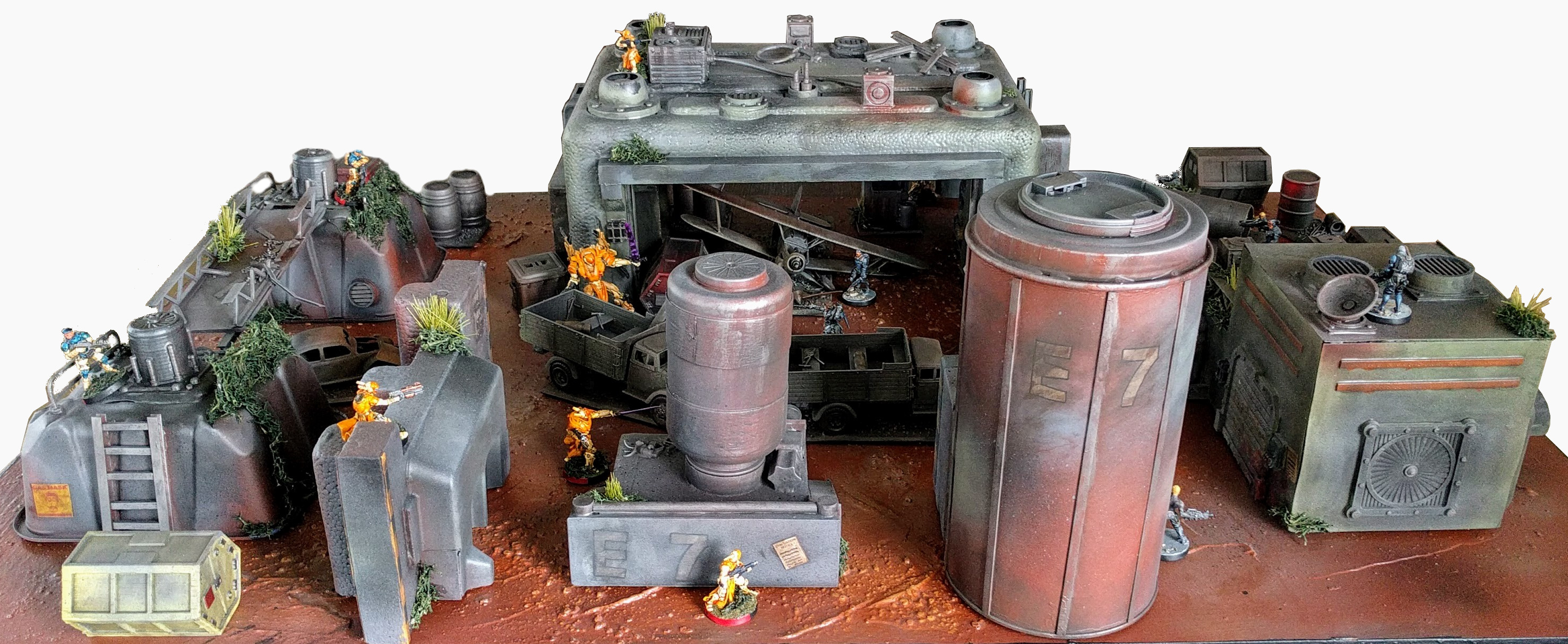
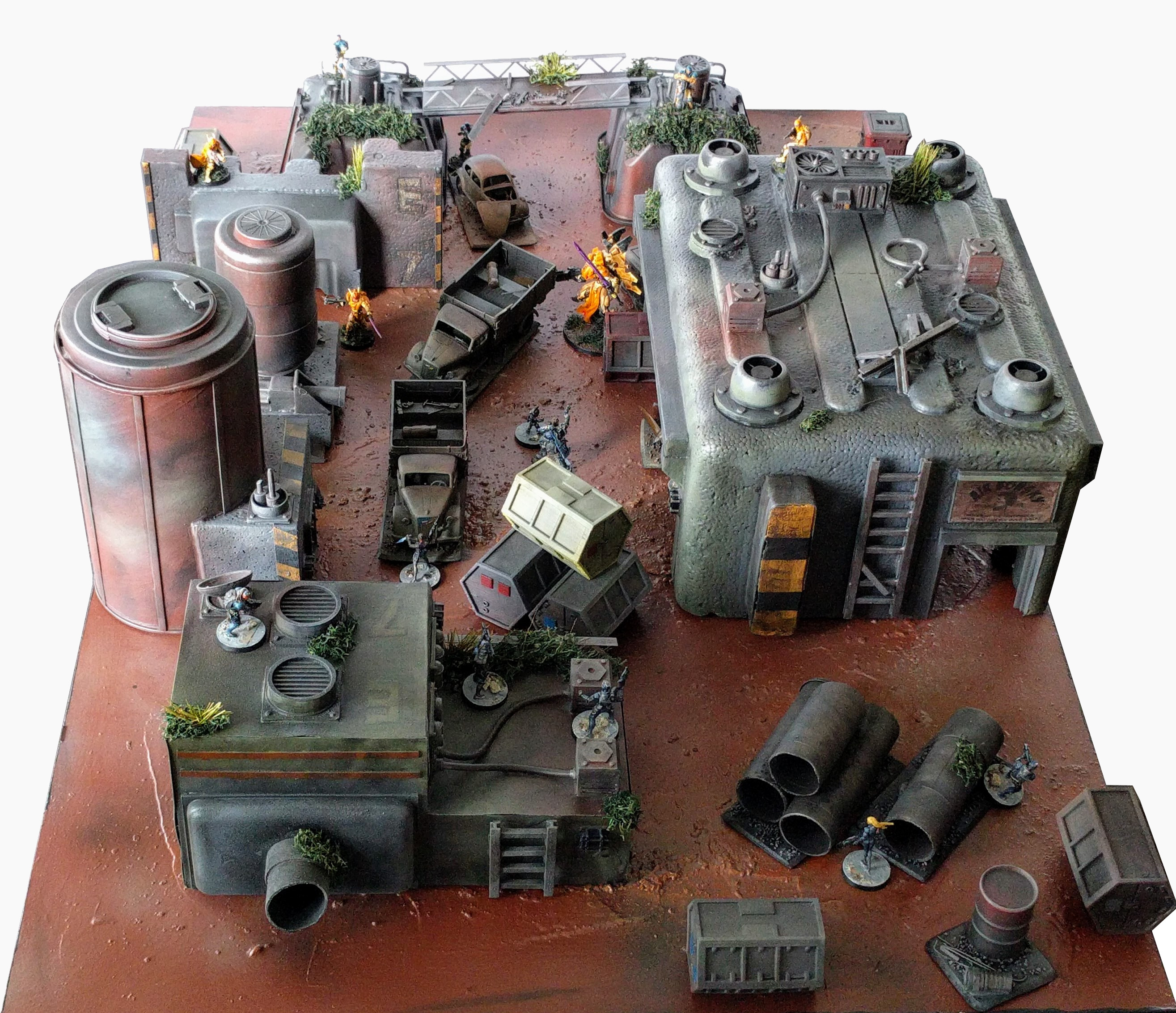
The Derelict Depot is a board I put together for RECON+, essentially half-size games of Infinity, but it should work for a variety of skirmish games. It’s a mix of scratchbuilding, scale models, and 3D printing. More details on its creation are here:

I designed all of the 3D printed parts. Many of them are already available as free downloads in my Thingiverse collection.

The armies fighting it out here are my Military Orders and Aleph painted by Tim D.

The first step: Putting down some initial ideas.

3D printed and scratchbuilt elements.

Construction complete!

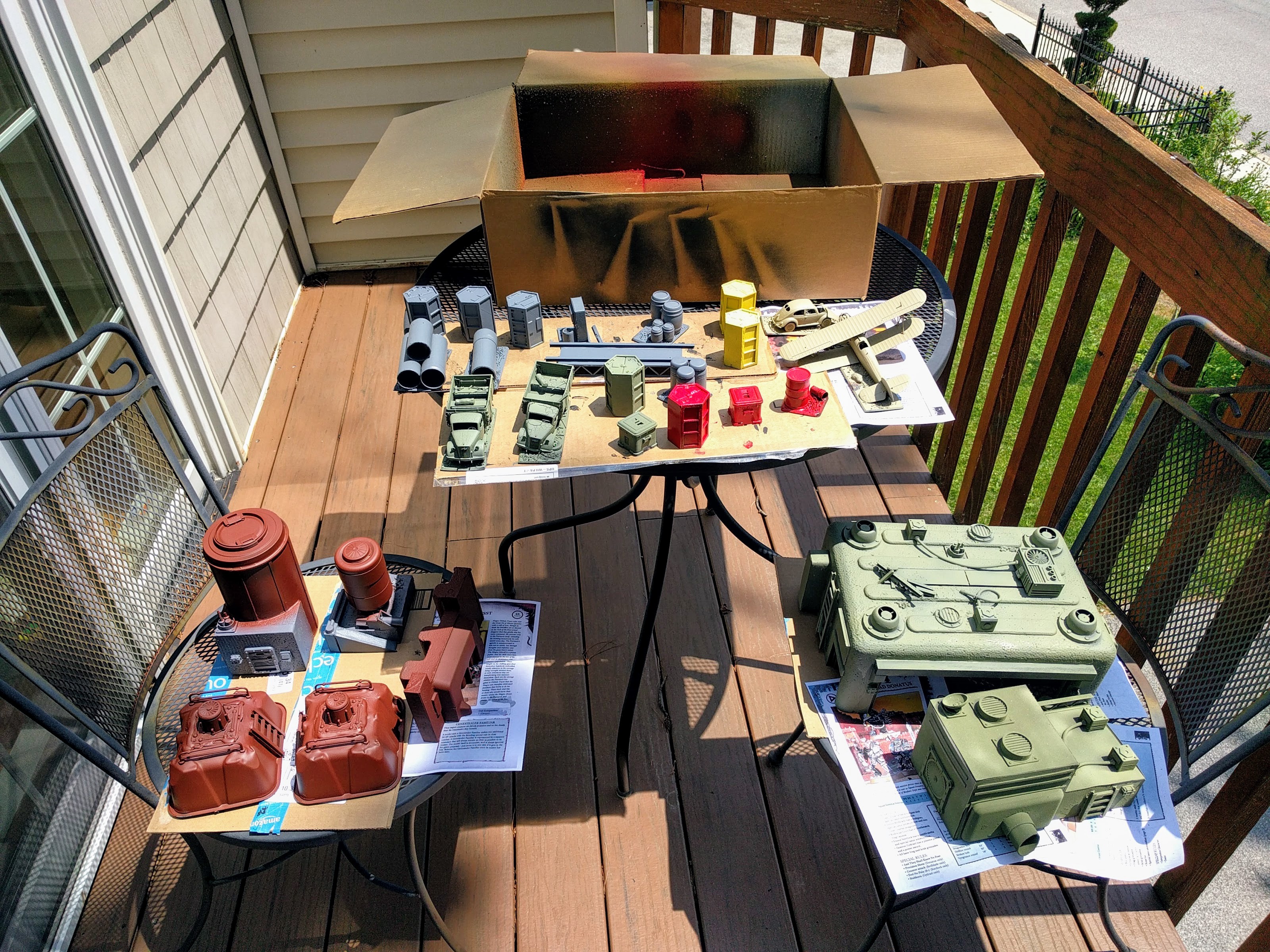
Base coating.

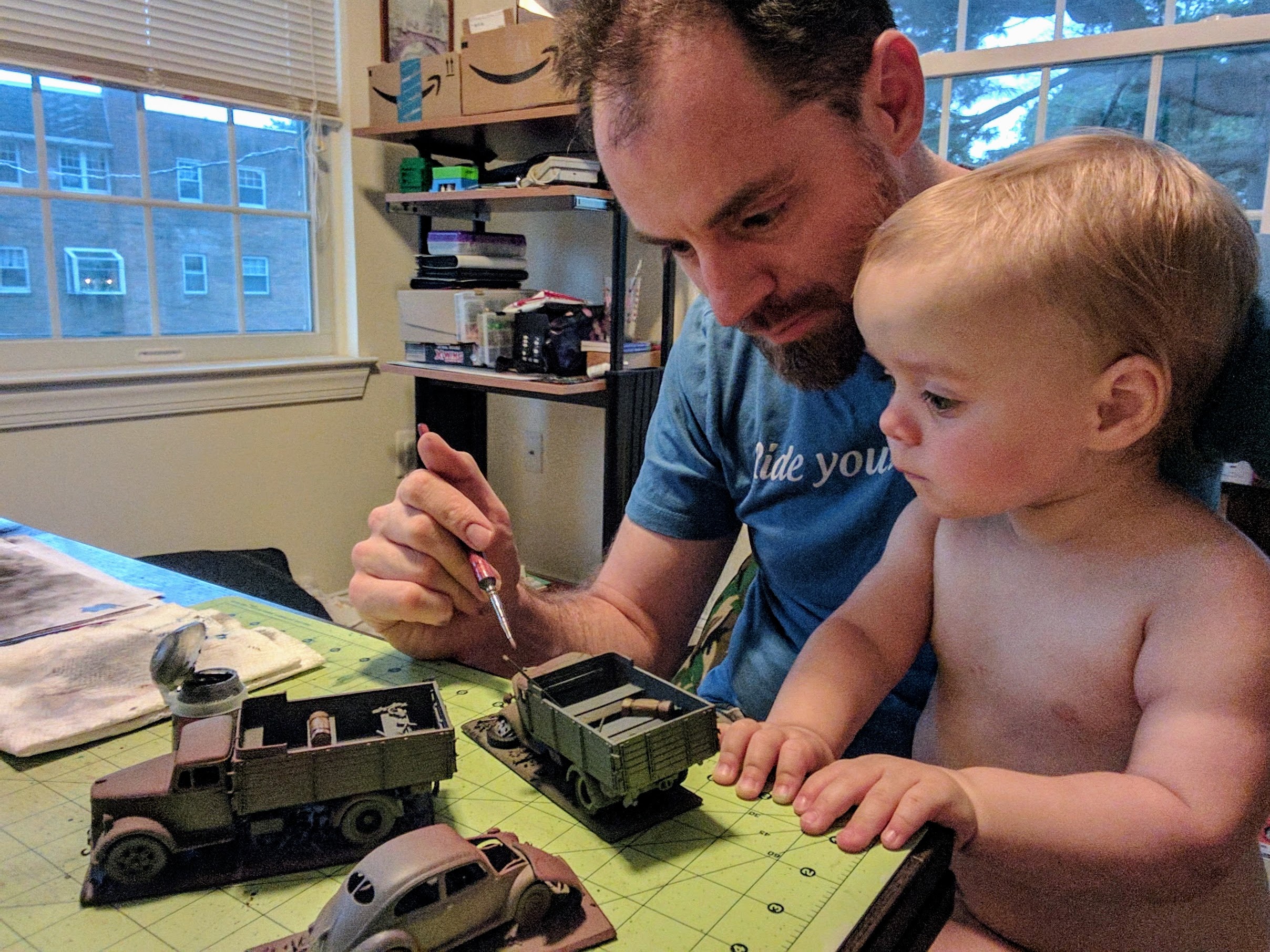
Painting details.

The final board!

Narrative

The story of this terrain is something like:

Early in the colonization of Ariadna, Depot E-7 was a supply outpost used by militias fighting the antipodes on the fringe of the settled area. As the border expanded outward and it was no longer militarily useful, a bold, risk-taking entrepreneur began using it as a base for an air courier service. Given the harsh conditions, limited technology, and few resources available to the colonists, its equipment was all based on very old and simple technology easy to construct and maintain. The service provided an important link ferrying supplies, messages, and people over the dangerous ground between the new, far flung settlements popping up as the colony grew rapidly. Later though the depot was overrun as its region collapsed in one of the periodic waves of antipode fighting. Although abandoned since then, it has recently come to be occasionally used as a waypoint or temporary base by various special forces teams operating on Ariadna.

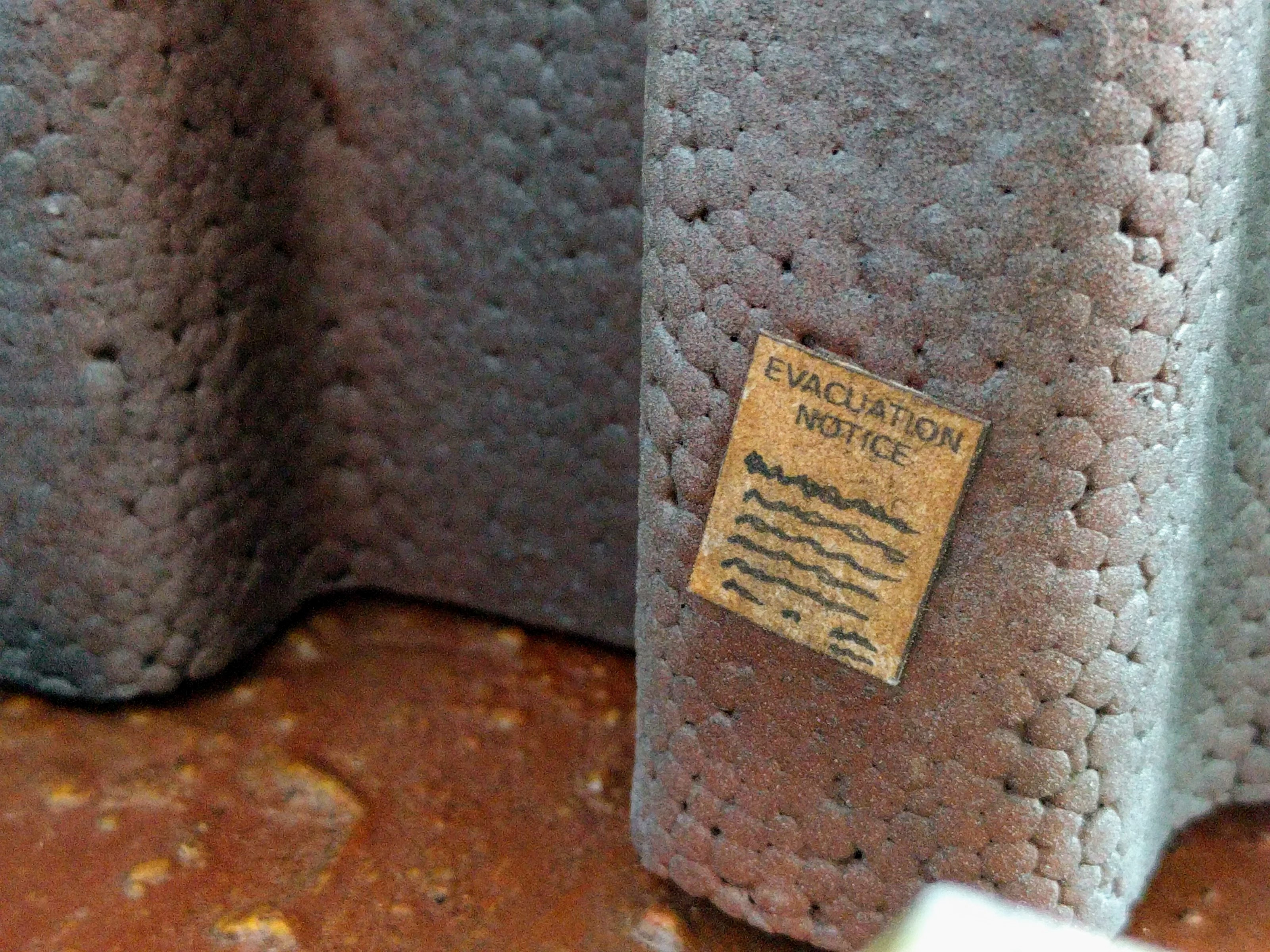
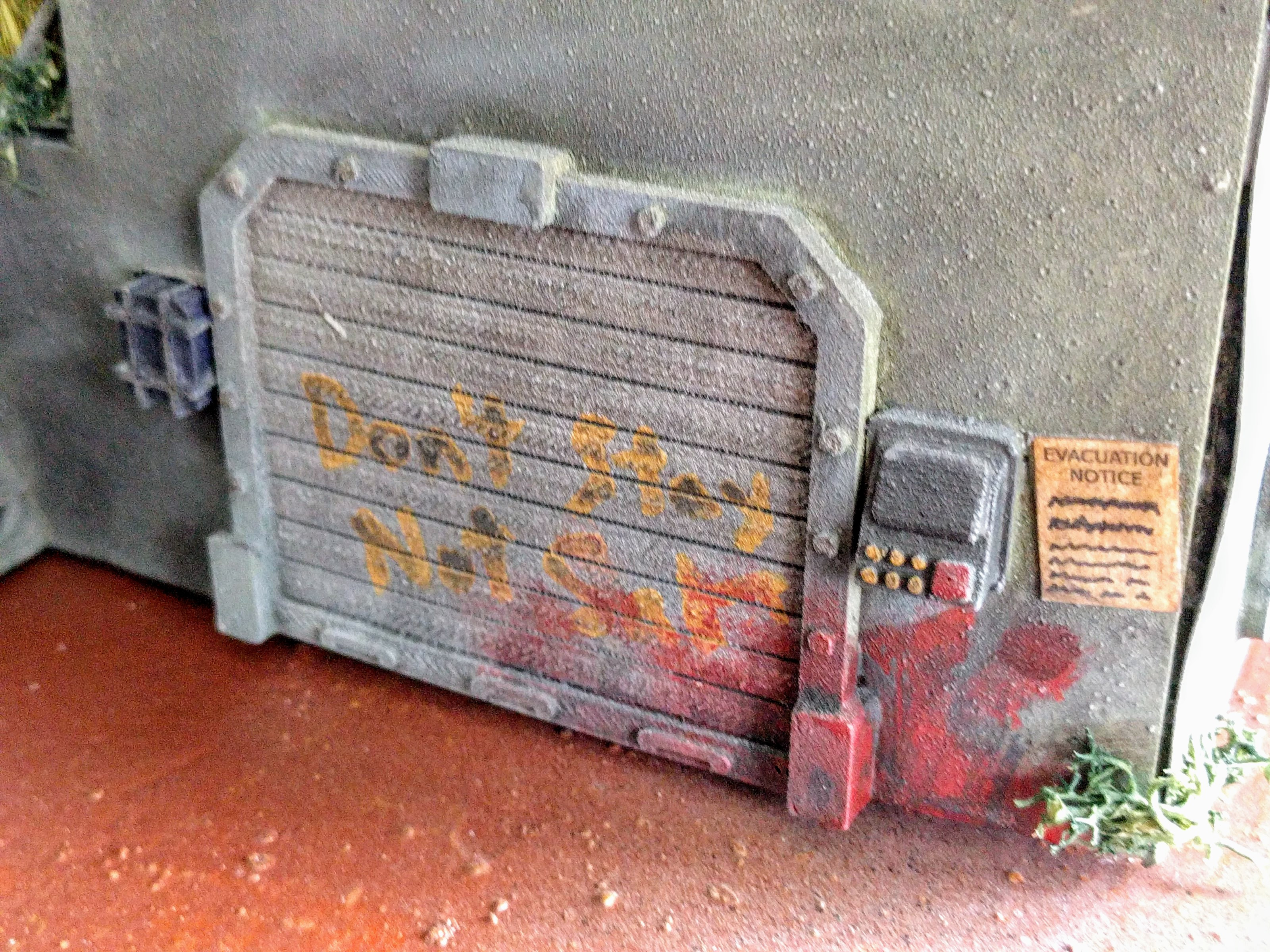
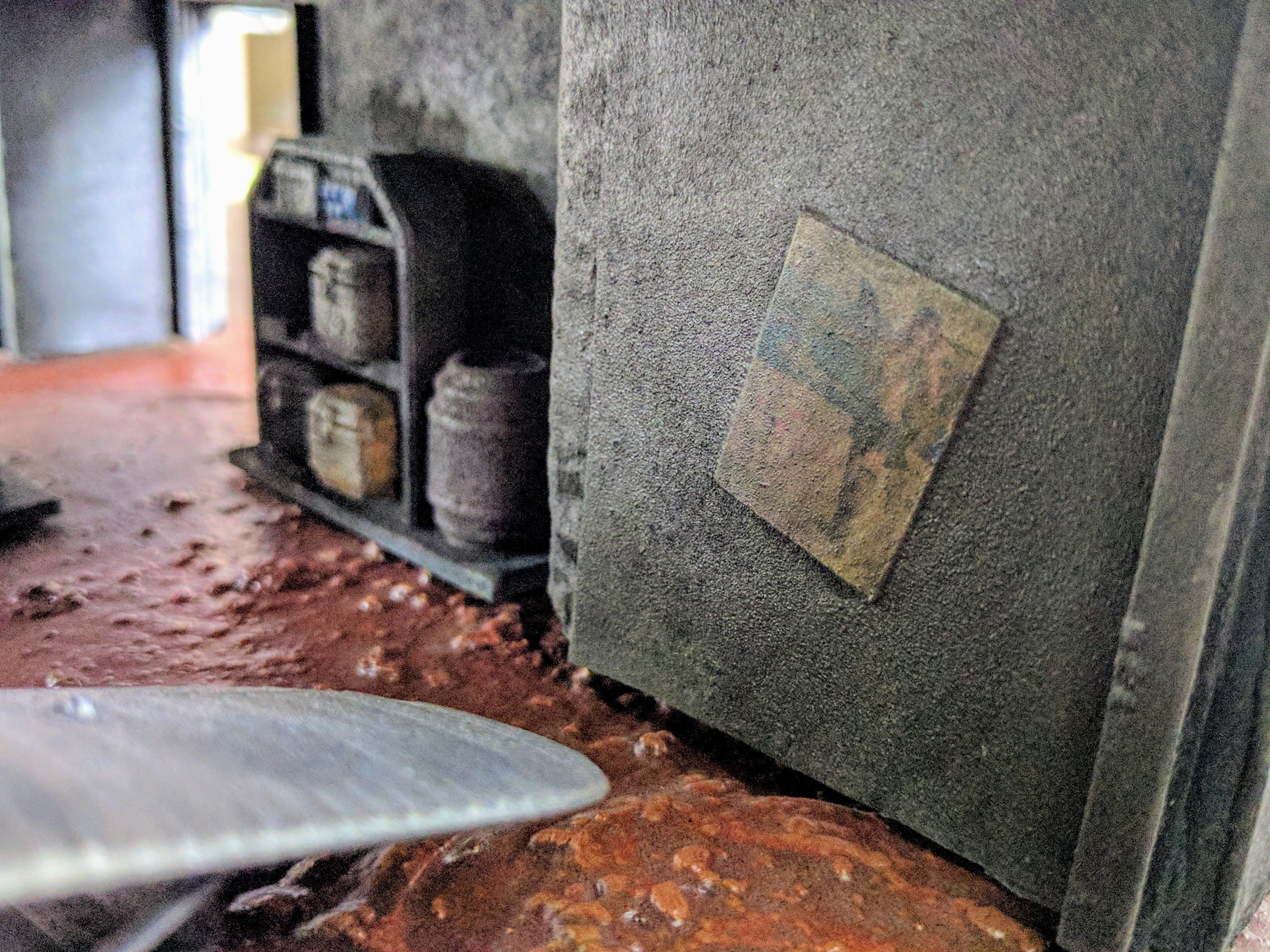
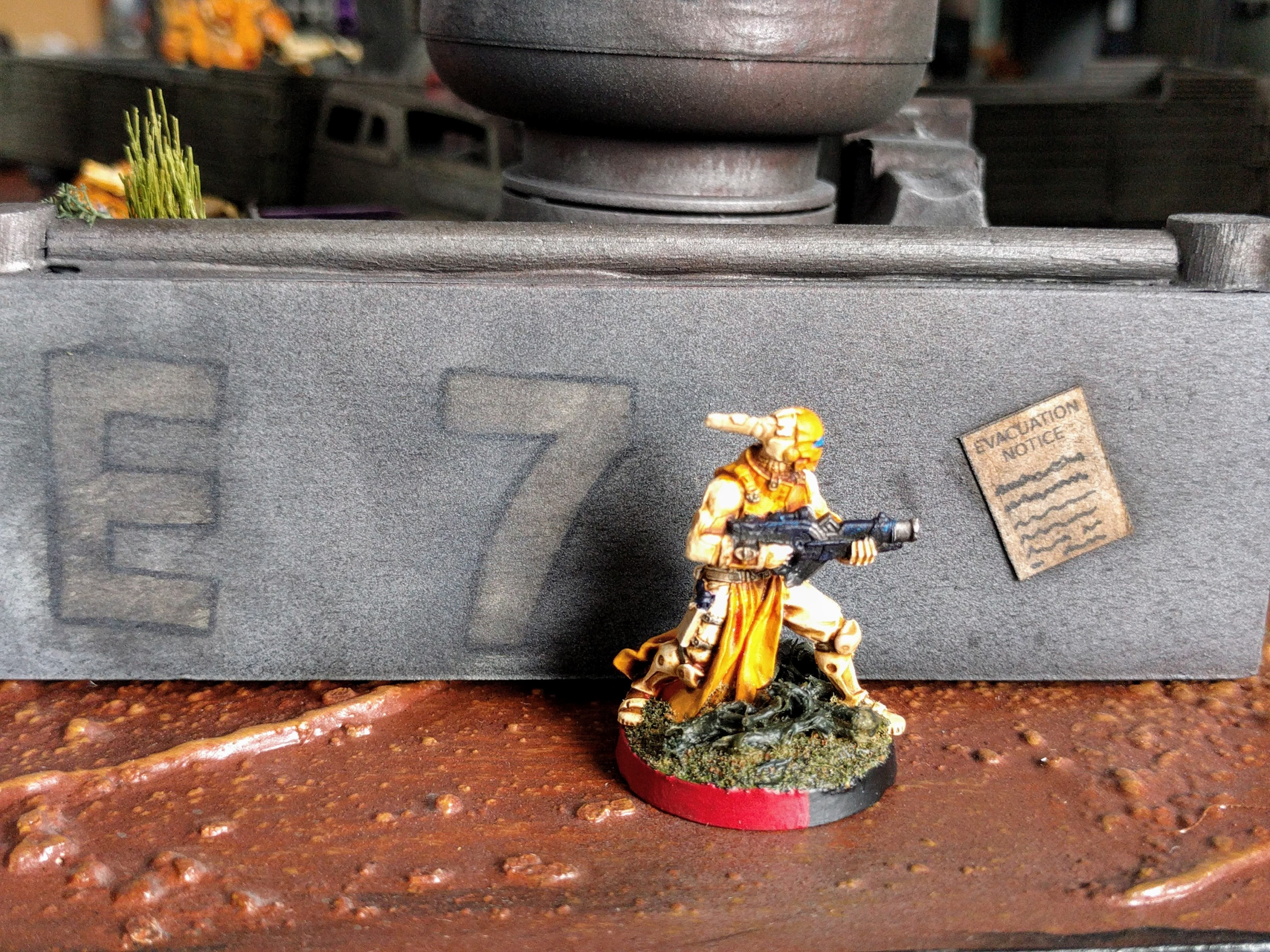
The board is of course designed overall to feel abandoned and disused, but particulars of that story are captured in details here and there: Signage declares the garage to be the home of the “Air Bonsky” courier service (Bonsky being our local lead Infinity TO); militia recruitment and “EVACUATION NOTICE” posters are scattered about on some of the walls and littered on the floor; blood spatters mark where the last defender was caught when the base was overrun; a walkway has been twisted and burnt by high explosives in more recent fighting. It’s not much of a story, but it was just enough to generate some unique, cohesive imagined micro-vignettes and details to add flavor.

Air Bonsky: Why fight the antipodes when you can fly over them?

Evacuation notice poster on a wall.

Littered recruitment poster and evac notice handbill blown into a corner.

A warning not finished in time.

Play

This board is definitely designed with just a bit of priority toward aesthetics and narrative versus gameplay. In a few places it can be a touch awkward to place figures because of details, many of the shapes are slightly odd so models often don’t perfectly snug up into cover, and so on. But it’s very playable, and has interesting features.

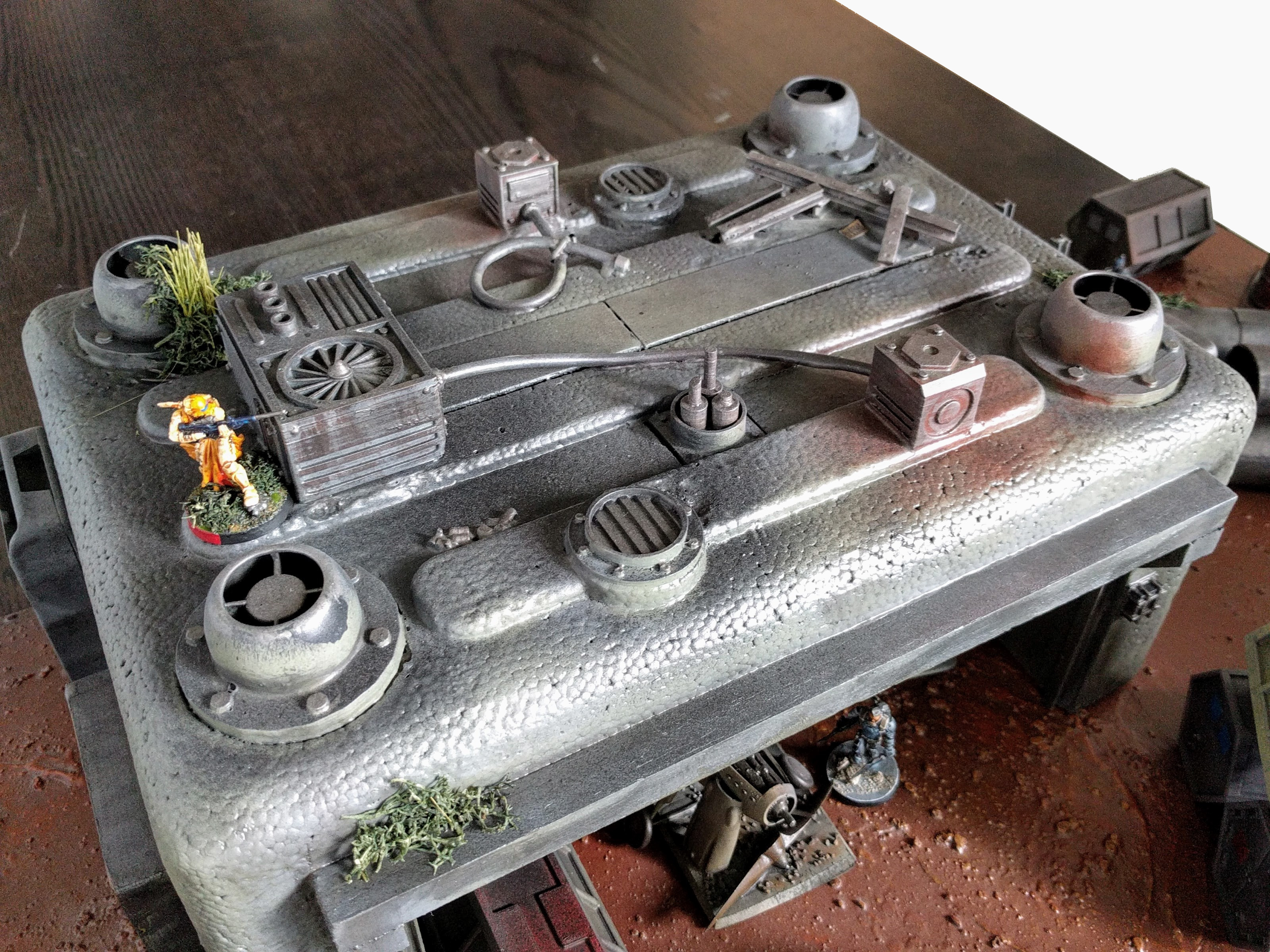
As one example, none of the buildings have the ubiquitous low walls found on almost all Infinity MDF terrain. In places where railings make real-world sense and cover would be useful for gameplay, the metalwork is more realistically thin and open, but overgrown in thick vegetation to physically obscure models and leave no doubt they’re intended to be cover. In other places, a variety of mechanical boxes, large vent outlets, and other details scattered about provide partial cover instead of walls and screens. This approach creates some interesting dynamics. For example, the top of the garage can be a great vantage point for controlling ground below. But it’s essentially not possible to move around on it without either breaking cover between features or going prone out of sight and foregoing your own shooting, quite different from moving along a rooftop railing or edge. At the same time, it’s not possible to get cover from all angles, so no sniper can rest easy if there’s a chance the enemy can flank them—which they might very well do by running through the garage directly underneath them!

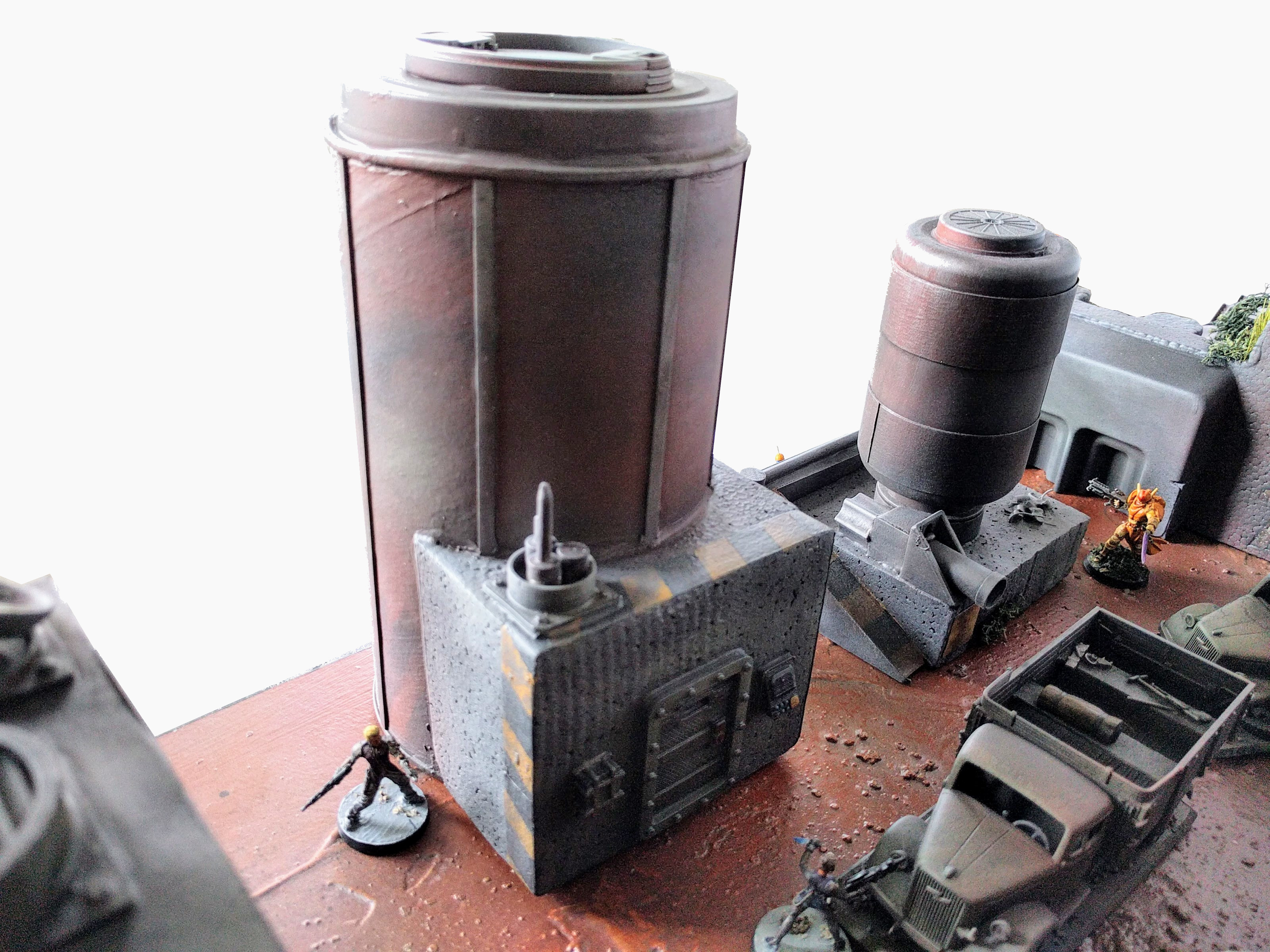
Similarly, the tallest point, the silo, has a piece on top such that models can generally only be placed solidly at the very center. A small lip prevents models from fitting at the edge. So a sniper can be placed there for a commanding view, but if they go prone they won’t be able to shoot anything, and if they stand up they won’t get cover.

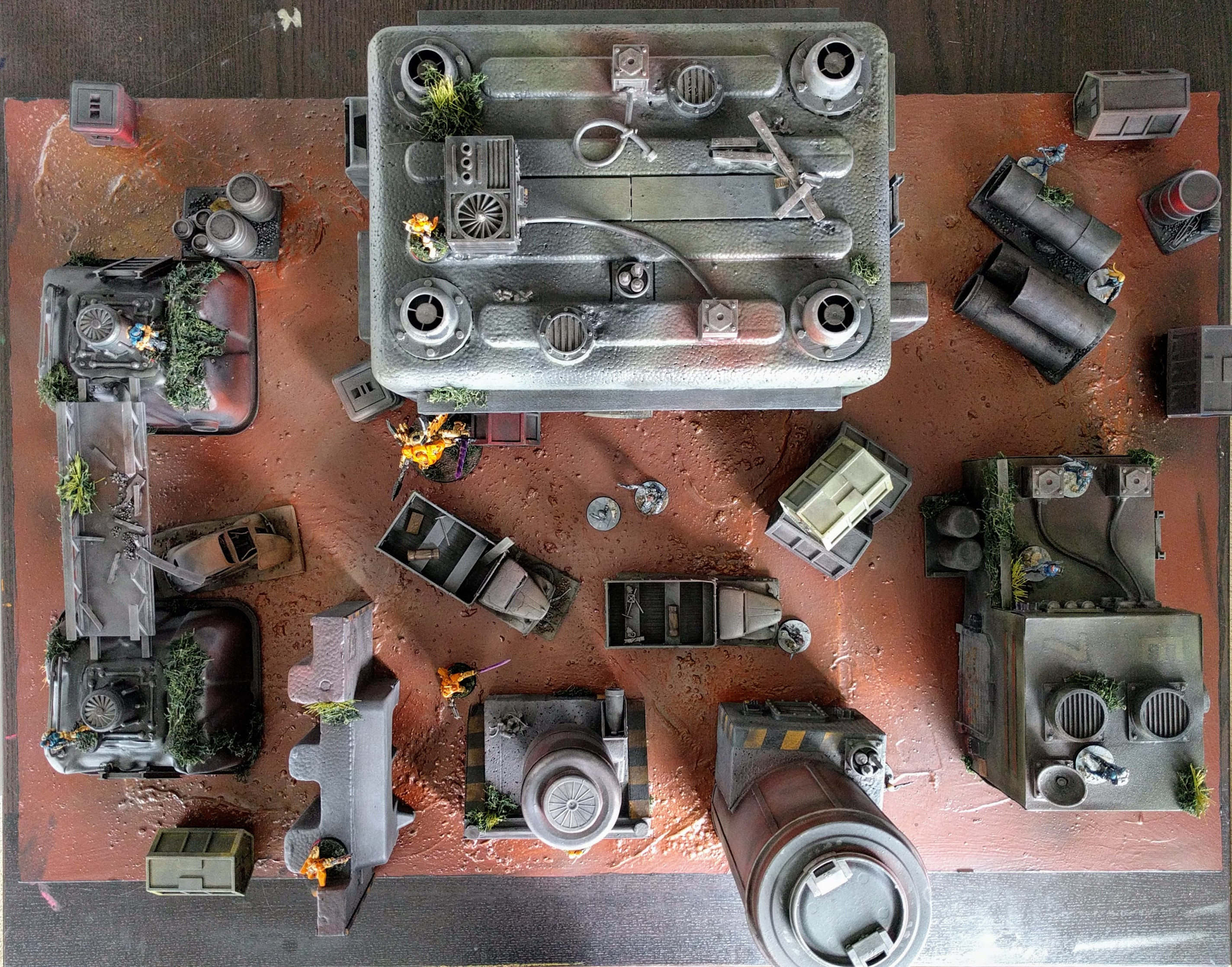
The board as shown here is very dense, which impacts some armies negatively, but that just means there’s plenty of pieces to be used or not used in different games, generating a lot of variety in potential setups.

Face-on view.

Mechanical building side.

Fuel reservoirs side.

Top view.

Sniper hiding behind a rooftop mechanical box.

Roof of the garage.

Poster inside the garage.

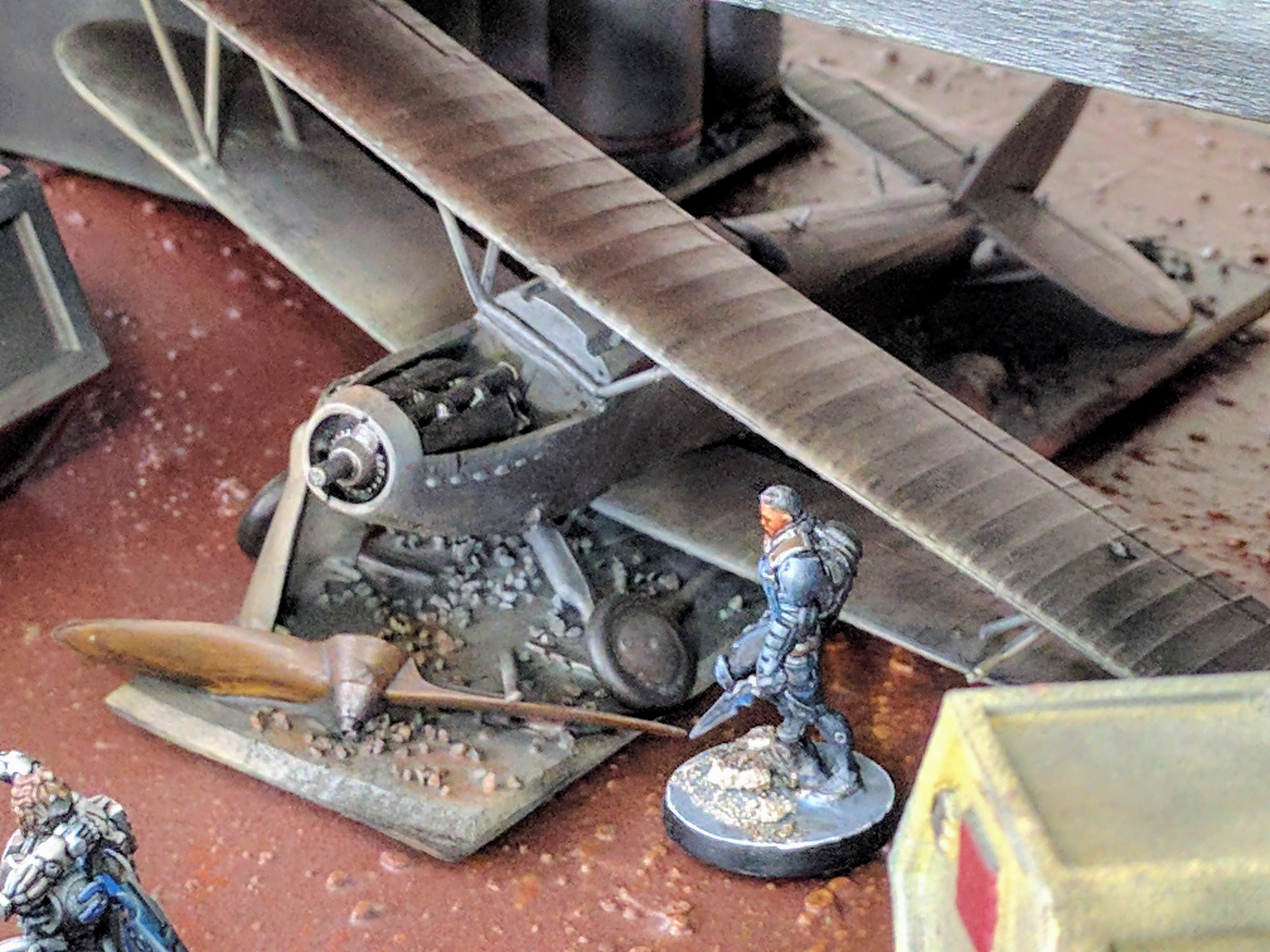
One of Bonsky’s relic aircraft.

The mechanical building.

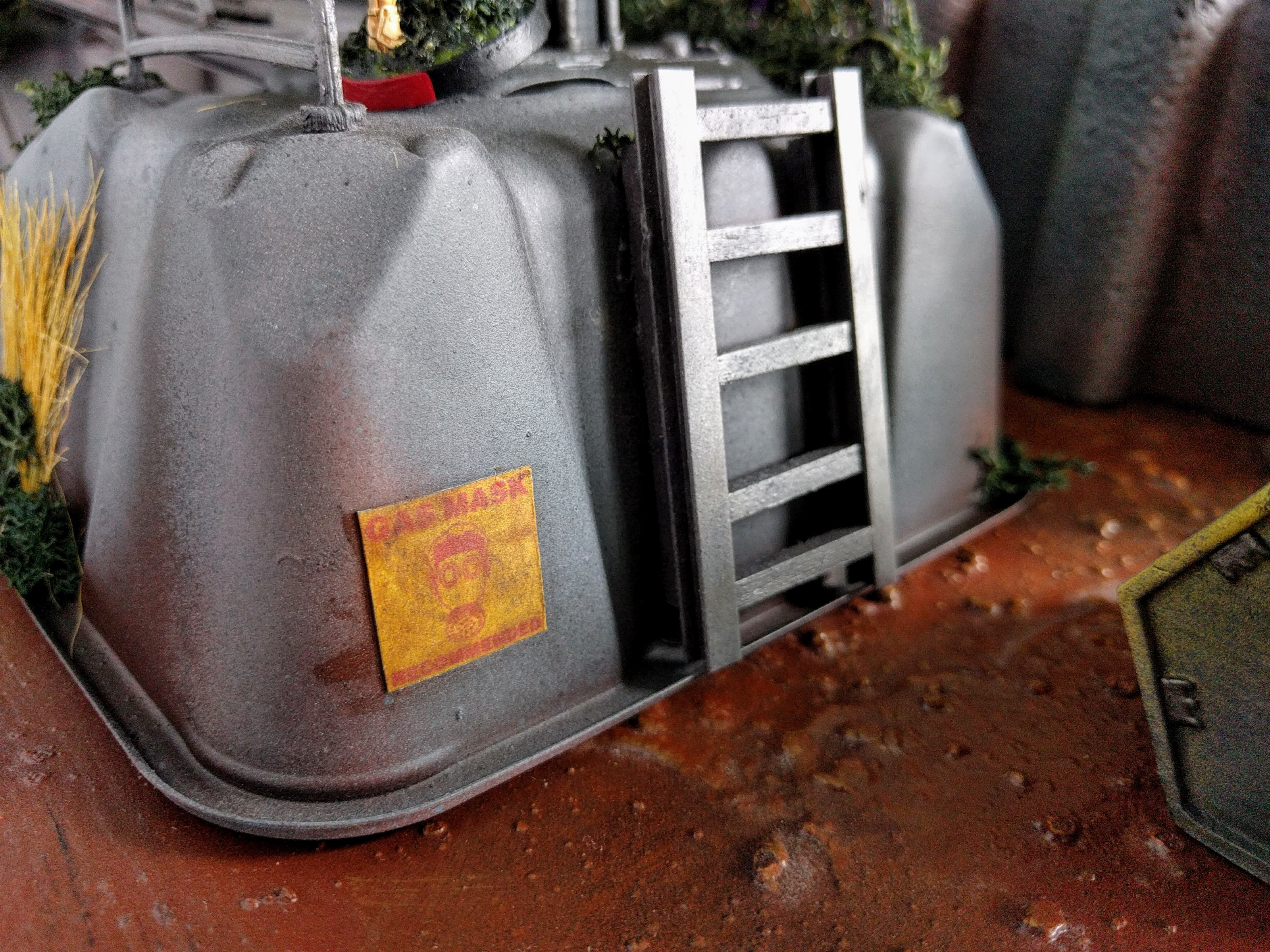
Gas mask warning and ladder on a fuel reservoir.

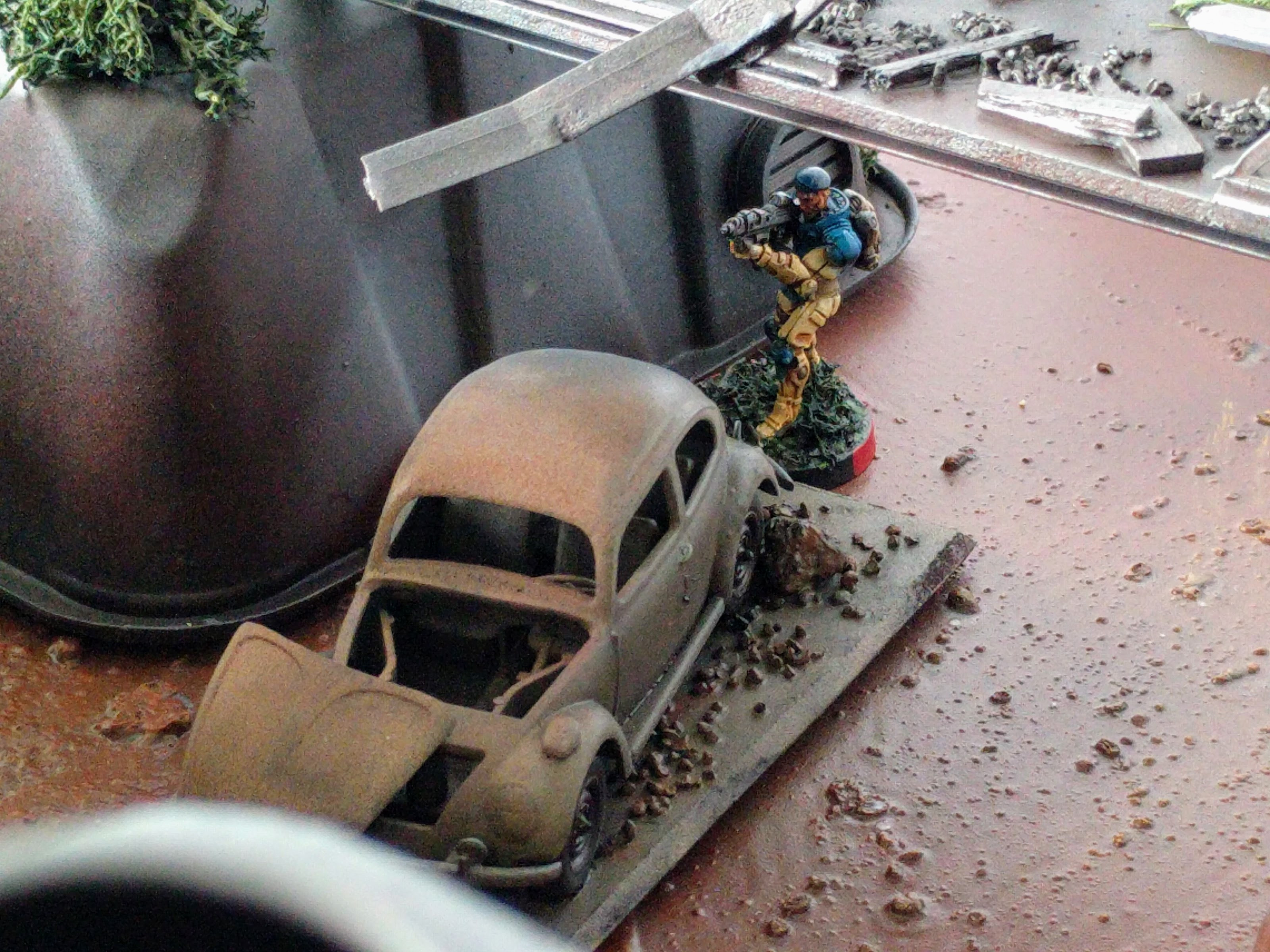
Burnt out low-tech car.

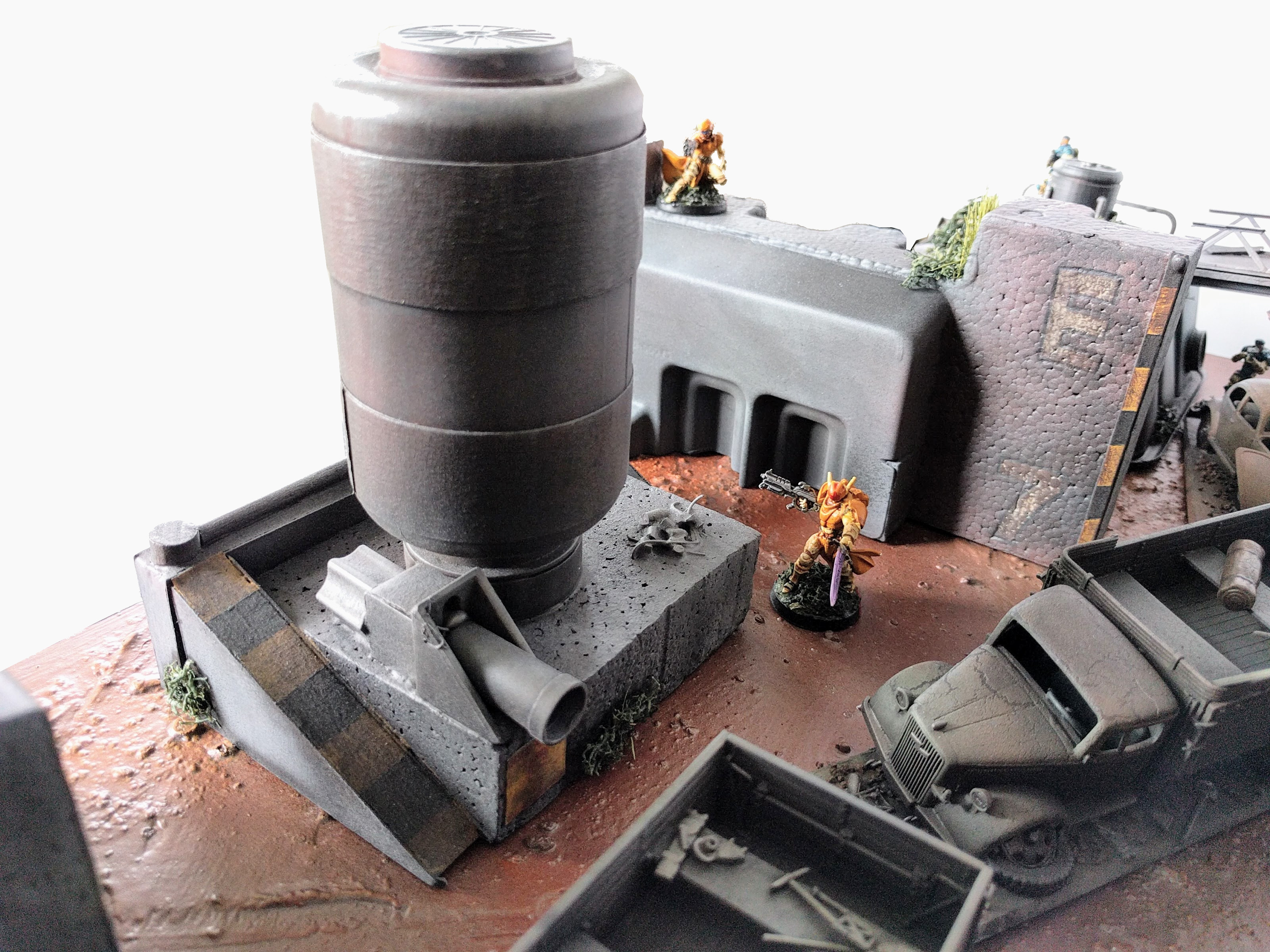
Fuel distribution tank.

Creeping behind the distribution tank.

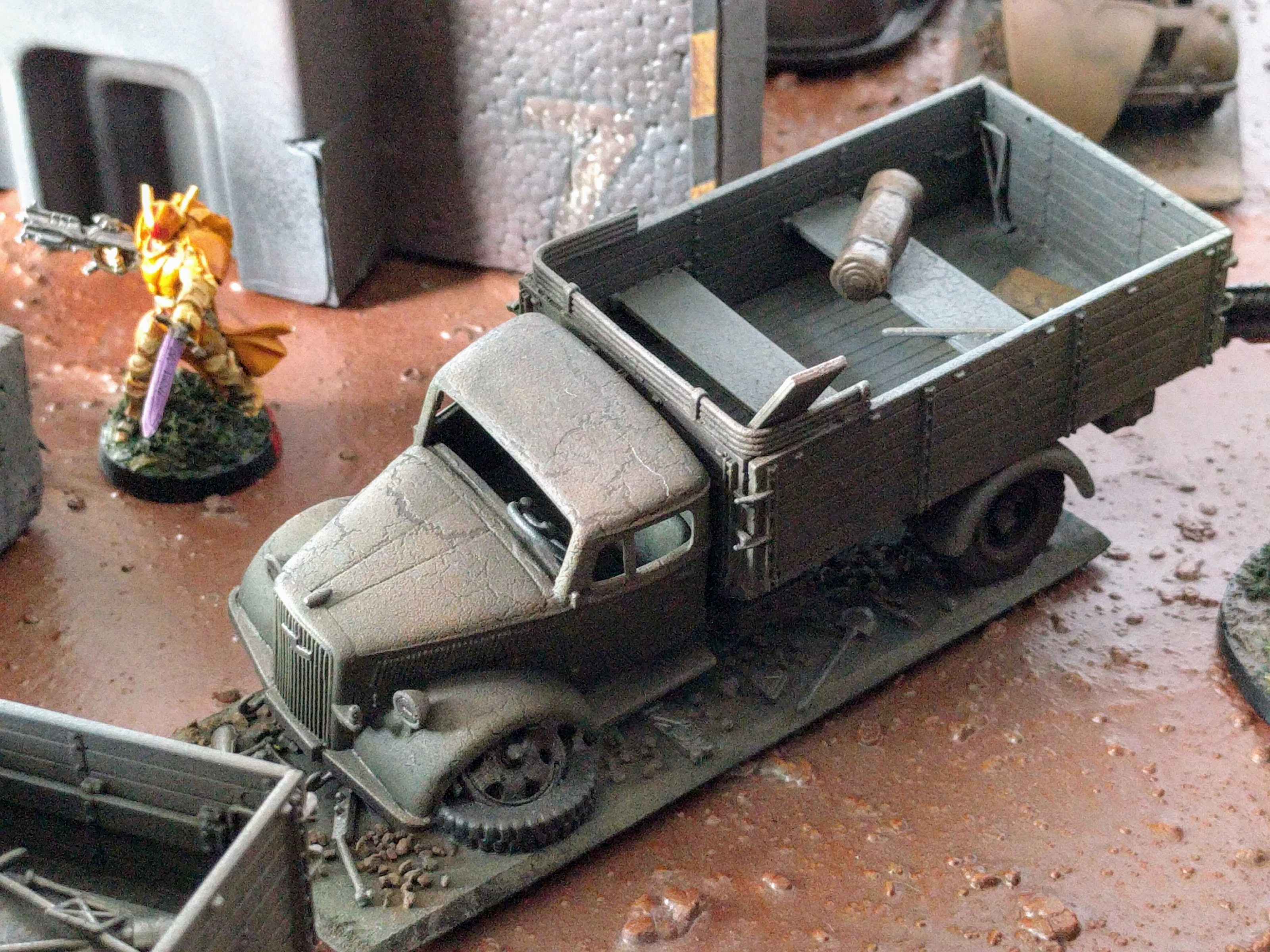
Truck dumped out front the distribution tank.

A silo, the tallest point on the board.

Door on the silo and truck left outside.

Next!

I’m very happy with how the Derelict Depot came together. It was a nice, tractable effort that didn’t drag on forever, and got done on schedule—just barely!—for an event I wanted to use it in. My small library of 3D printable parts made expressly to quickly add details to scratchbuilt terrain like this provided plenty of variety and interesting features, and I enjoyed making good use of a number of found objects. People seem to enjoy playing on the board, the pieces have some neat game dynamics, and the terrain has a lot of character and cool visuals. Mission accomplished!

For another example of this kind of scratchbuilding + scale models + 3D printing, check out my Medea Refinery build. Partly by chance and partly by design, pieces from the two sets go together well to create a really cool, large, detailed board. I also have a few tutorials up on 3D printing and modeling.

I’m not sure quite when I’ll get to them with NOVA and other events coming up, but I’m kicking around a couple neat ideas for new boards and in some cases have even started some work. Stay tuned!

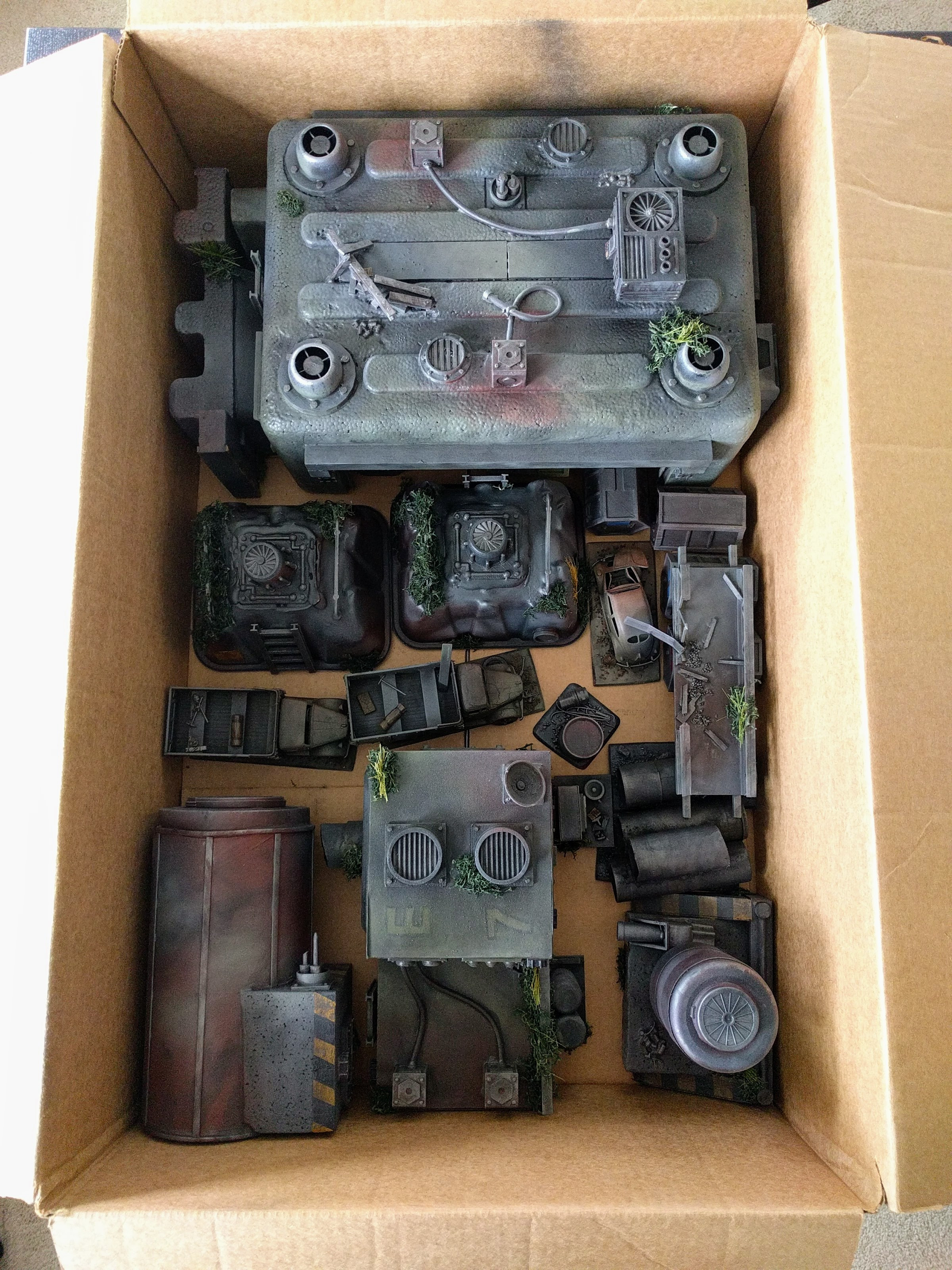
As a bonus, the Derelict Depot packs up perfectly into a box I had on hand!